
Published on:
Can You Sell a Crypto Payment Terminal Portfolio? What Your Residuals Are Worth as a Business Asset

Most people think about residuals as monthly income.
How much will I make in month six? What does the check look like at 20 merchants? Can I replace my salary?
Those are the right questions to start with. But they're not the complete picture. Because the income stream you build by placing crypto payment terminals isn't just a cash flow source. It's a business asset — one with an independent market value that exists separately from the income it generates every month.
The smarter question isn't only what your portfolio pays you. It's what your portfolio is worth.
How Payment Processing Portfolios Are Actually Valued
Merchant services residual portfolios have been bought and sold as financial assets for decades. This isn't a new concept invented for the crypto version of the model. It is a documented, established practice in the payment processing industry with a defined valuation methodology.
The standard approach applies a multiple to annual residual income. Industry-standard multiples for merchant services portfolios run two to four times annual residuals. The multiple applied in any specific transaction depends on portfolio quality, documented churn history, the stability of the processor relationship, merchant concentration risk, and market conditions at the time of sale.
The math is straightforward.
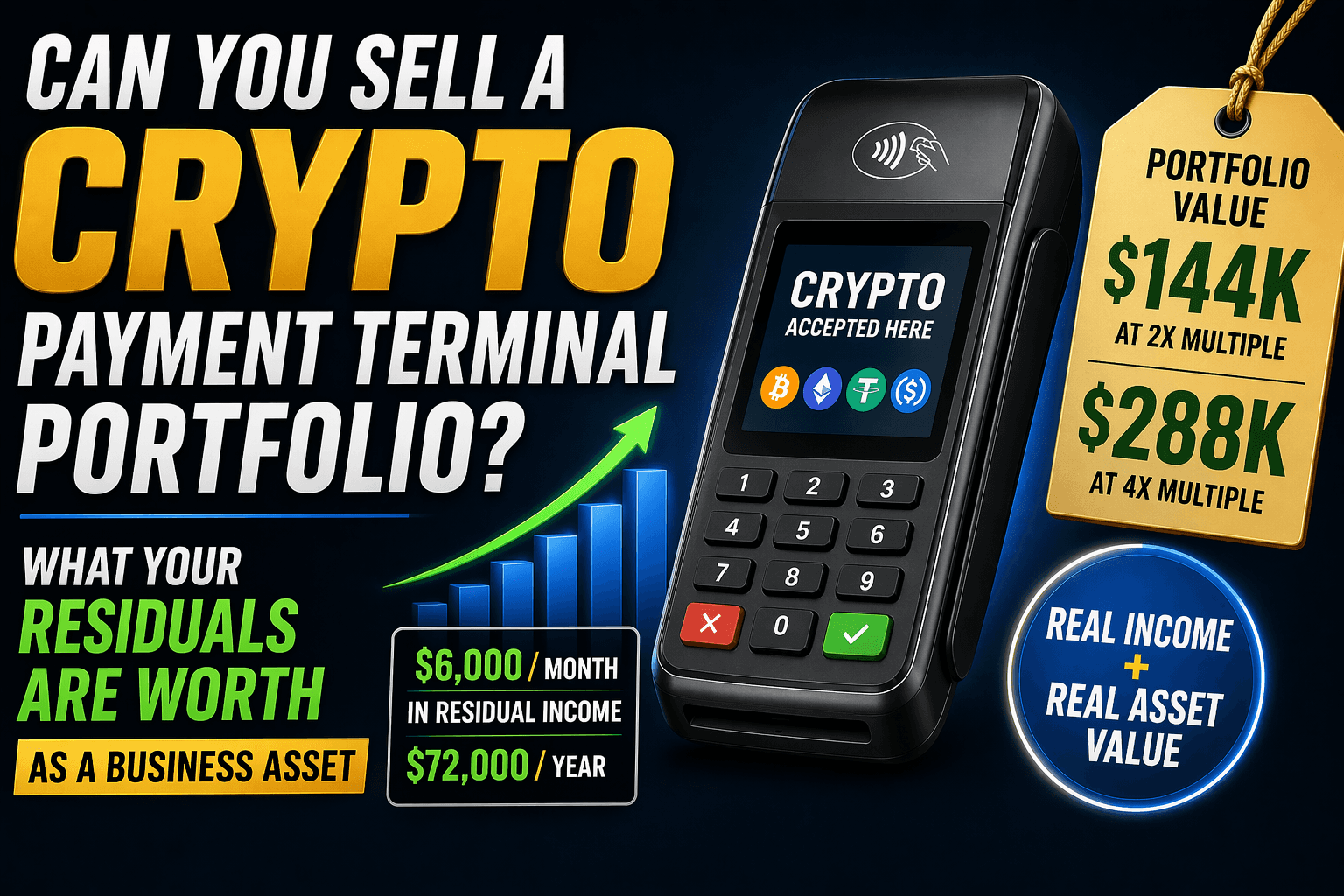
A portfolio of 20 merchants generating an average of $300 per month per merchant produces $6,000 per month in residual income. That's $72,000 per year. At a 2x multiple, the portfolio has an asset value of $144,000. At a 4x multiple, $288,000.
The income continues to flow while you hold it. The asset value exists on top of that income — a separate number that doesn't show up in any month's deposit but is nonetheless real.
What That Means Compared to Other Assets You Already Understand
The comparison that puts this in context fastest is a laundromat.
A laundromat generating $6,000 per month in net income — the same figure as the 20-merchant portfolio above — would sell for approximately $150,000 to $300,000 in a standard small business transaction. The multiple applied to laundromats and similar owner-operated cash flow businesses typically runs 2x to 3x annual net income for an established operation with documented performance.
The numbers are essentially identical.
The difference is in what you're buying and selling. A laundromat at that price comes with real estate lease obligations or purchase costs, commercial washers and dryers that depreciate and break, utility bills, employee coverage requirements, and the operational complexity of a physical location. The transaction costs to sell it run 6 to 8% in broker commissions and transfer fees.
A residual portfolio has no physical location. No equipment maintenance costs. No utilities. No employees. The transaction to transfer ownership is a contract reassignment with the processor. The operational burden on the buyer is the same ongoing light maintenance work the seller was doing — and in a mature portfolio with low attrition, that's minimal.
The comparable exit value is similar. The asset being sold is simpler by an order of magnitude.
ATM route businesses operate on a comparable logic. An ATM route generating $5,000 to $6,000 per month in net income from a portfolio of machines would sell for $100,000 to $200,000 depending on machine condition, lease terms, and location quality. But ATM routes carry physical infrastructure — machines that need restocking, maintenance, and eventual replacement. The residual portfolio carries none of that.
Why Someone Would Pay 3x for Income You Could Just Keep Collecting
This is the question that comes up, and it's the right one to ask.
The answer involves understanding who buys these portfolios and why.
The first buyer category is strategic acquirers — other agents or operators who want to scale their portfolio quickly. Adding 20 established merchant accounts to an existing portfolio is faster than placing 20 new terminals one at a time. The buyer pays a multiple for speed and for avoiding the placement work.
The second category is passive investors — people who want the recurring cash flow without doing any operational work. A well-documented portfolio with stable merchant relationships and low historical churn is attractive to a buyer who has capital but not time. They pay a multiple for the infrastructure that's already built and the income stream that's already running.
The third category is operator transitions — someone building a business for five years and then exiting to focus on something else. The portfolio they built represents their years of placement work converted into a lump-sum exit. They aren't leaving income on the table. They're harvesting the asset value that accumulated while they were building.
In each case, the buyer is paying for documented income history, the relationships that protect it, and the time they don't have to spend creating it themselves. That's what a multiple compensates.
The Comparison That No One Makes at the Kitchen Table
Consider three ways to generate $6,000 per month in income.
Option one is a W-2 salary generating equivalent after-tax income. It pays every month as long as you're employed. The day you leave or lose the job, it stops. It cannot be transferred to another person. It cannot be sold. Its terminal value — what it's worth as an asset on the day you decide to do something else — is exactly zero.
Option two is a rental property generating $6,000 per month in net rent after mortgage, maintenance, insurance, and property management. It has asset value beyond the income, which is the argument for real estate. But that asset value comes with cap rate risk tied to interest rate environments, depreciation, maintenance reserves, and a transaction cost of 6 to 8% to sell. A property generating that income in most U.S. markets requires a significant capital base — often $500,000 to $1,500,000 in property value — and the income is not guaranteed. Vacancies, repairs, and difficult tenants interrupt it.
Option three is a residual portfolio generating the same $6,000 per month. It has asset value of $144,000 to $288,000 at standard industry multiples, in addition to the income. It requires no physical asset, no debt, no maintenance reserves. Its transaction cost to sell is a fraction of real estate. And the income continues uninterrupted while you hold it.
The financial comparison isn't complicated. It's just a comparison that doesn't happen because most people aren't aware that the third option exists.
The PayPal-Era Parallel That Explains the Timing
In the mid-1990s, internet payment processing was new. The agents and ISOs who built merchant portfolios during that window — placing credit card processing infrastructure at businesses that had never accepted cards online — weren't just earning residuals. They were building assets.
When the consolidation came — when the major processors and banks started acquiring independent portfolios — those early operators had something to sell. The income stream they had been collecting got converted into exit proceeds. The multiple applied to their annual residuals produced lump-sum outcomes that bore no resemblance to what they would have earned simply keeping the income.
The agents who moved early and built clean, documented portfolios exited well. The ones who waited until the market was saturated competed for scraps in a crowded field.
Crypto payment terminal placement is in an earlier structural phase than internet card processing was in 1995. Less than 0.01% of U.S. small businesses currently accept crypto directly. The portfolio being built today is being built before the market has any institutional density — which means it's being built before portfolio buyers start competing aggressively for established books of business.
The income available now is real. The asset being built simultaneously is what makes the timing argument genuinely different from a pitch.
The Honest Constraint on Portfolio Valuation
Merchant services portfolio valuations are not guaranteed at any specific multiple. A buyer will apply their own analysis to what they're purchasing, and that analysis will reflect the portfolio's actual quality.
Merchant concentration risk matters. A portfolio of 20 merchants where five of them represent 60% of the monthly residual is more vulnerable than a portfolio where no single merchant accounts for more than 10% of income. Buyers discount concentration risk.
Documented churn history matters. A portfolio with a demonstrated retention rate and stable merchant relationships commands a higher multiple than one where accounts have been turning over frequently. The retention data described in the previous posts — hardware switching costs, relationship stickiness, the structural protections on residuals — translates directly into portfolio valuation at exit.
Processor relationship terms matter. The stability and terms of the agreement between the agent and the licensed processor affects what a buyer is acquiring. A portfolio sitting on a well-documented, stable processor relationship is a different asset than one with uncertain continuation terms.
The portfolio value is real. It is also earned — through quality placements, merchant relationships that hold, and the kind of documented operating history that a buyer can underwrite.
The Income Is the Obvious Value. The Asset Is the Bonus.
Most people who evaluate this model run the monthly income math. They should. The income case stands on its own.
But the complete picture includes a second number — the asset value accumulating in parallel with every month of residuals collected. A portfolio generating $6,000 per month isn't just a $72,000-per-year income stream. It's a $144,000-to-$288,000 asset that can be held for income, sold for a lump sum, or transferred to someone else who continues collecting what you built.
W-2 income doesn't have a terminal value. It doesn't have an exit.
This does.
The Dividend Shift Team supports partners building residual income through crypto payment terminal placement. Dividend Shift was founded by Gedam Tekle, a former U.S. Marine and Oakland Police Sergeant who has personally exited two eight-figure companies and helped over 4,000 entrepreneurs build infrastructure-based businesses.