Published on:
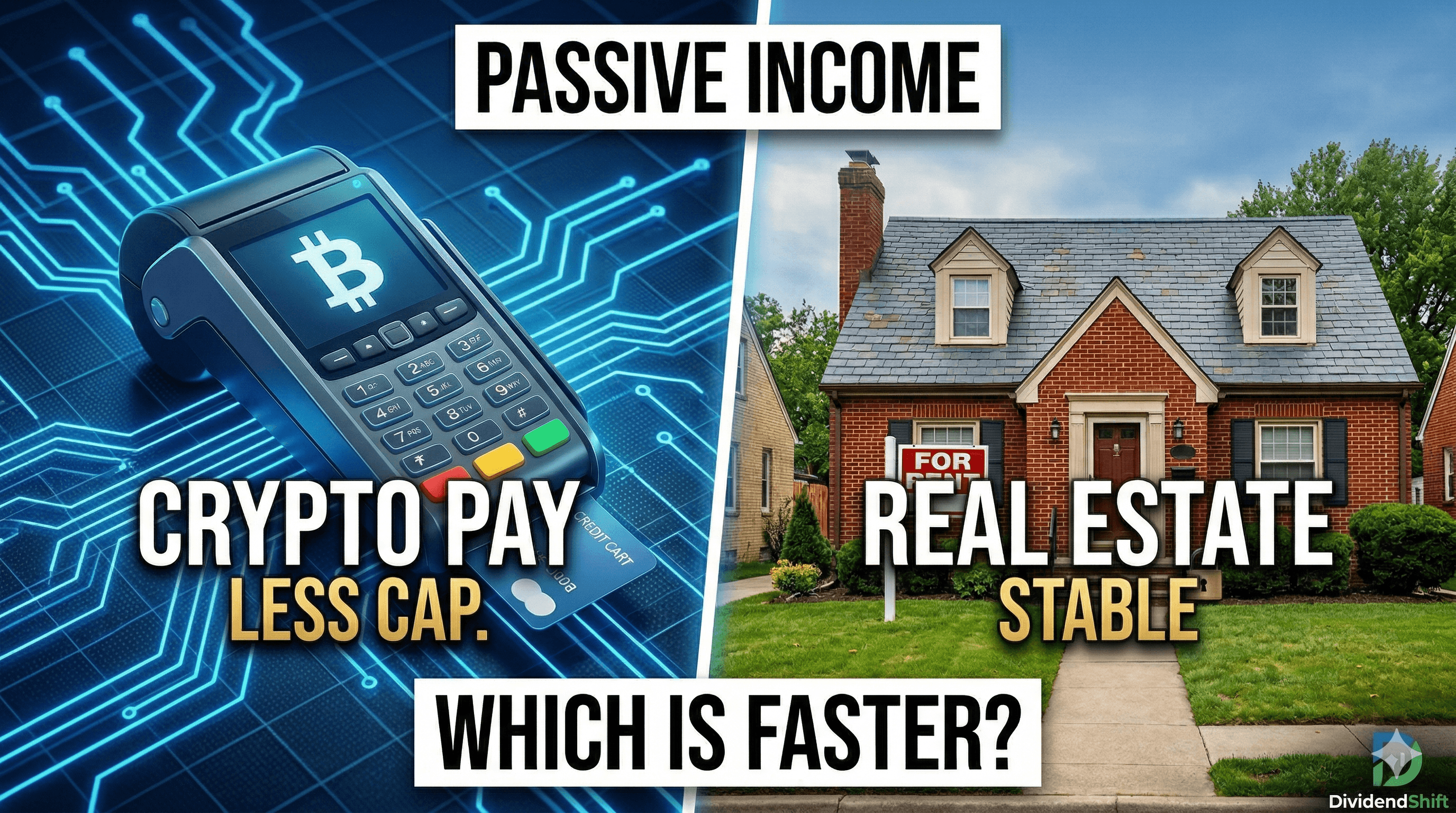
Crypto Payment Processing vs. Real Estate: Which Builds Passive Income Faster With Less Capital?
Crypto Payment Processing vs. Real Estate: Which Builds Passive Income Faster With Less Capital?
Real estate is the answer everyone gives when you ask about passive income. Your parents believe in it. Your coworkers talk about it. Every financial influencer has a rental property story.
I'm not here to tell you real estate is wrong. It's not. I own assets. I understand the value of something that appreciates while you sleep.
But I want to have an honest conversation about what real estate actually requires — and what it actually delivers — because for most people in the $80K–$150K household income range, the real estate path looks very different in practice than it does in theory.
Then I want to show you what the comparison looks like when you put crypto payment terminal placement next to it.
Side by side. Honest numbers. No hype on either end.
What Real Estate Actually Costs to Get Started
Let's say you want to buy a single-family rental home.
The median home price in the U.S. sits around $400,000. A standard investment property down payment runs 20–25%, so you're putting $80,000 to $100,000 down before you own anything.
Add closing costs — typically 2–5% — and you've deployed $90,000 to $120,000 before your tenant moves in.
Then the clock starts on financing. At current rates, a $320,000 mortgage costs roughly $2,100 to $2,400 per month in principal and interest alone. Add property taxes, insurance, maintenance reserves, and property management (typically 8–12% of rent), and your break-even rent number is higher than most people calculate before they buy.
After all of that, a well-run single-family rental in a decent market nets $200 to $500 per month in actual cash flow.
Some months. Because the month you replace a water heater or deal with a tenant who stops paying, those months go negative.
The time to first dollar: four to six weeks minimum after closing, assuming you find a tenant immediately. The time to
actually profitable cash flow, after factoring in vacancy, turnover costs, and the occasional capital expense: often 12 to 24 months.
None of this is hypothetical. These are standard numbers from anyone who has actually run a rental portfolio.
What Real Estate Does That Nothing Else Does
Now here's where I'm going to be straight with you, because I said I wasn't going to trash real estate.
Real estate builds equity. Your tenant pays down your mortgage. The property appreciates — historically about 4% annually in the U.S. over the long run. You get depreciation write-offs. In 20 years, if you've held the asset and managed it reasonably well, you own something worth significantly more than what you paid.
That's real. That's powerful. That's generational wealth when it works.
The question is not whether real estate works. It does. The question is: what does it require, and does that match what you actually have available right now?
For most people reading this — Marcus, 42 years old, $120K household income, decent credit, one mortgage already on the primary residence — the path to a rental property is genuinely difficult. Getting a second mortgage at a reasonable rate while carrying the first one is harder than the real estate YouTube channels make it look. And even if you get there, you have $100,000+ tied up, you're a landlord, and your "passive income" involves phone calls about broken appliances.
What Crypto Payment Terminal Placement Actually Costs
Let me walk through the real cost structure on the other side of this comparison.
Equipment runs $200 to $1,500 per terminal. No cash float. No inventory. No property. The Dividend Shift model is a done-with-you licensing program — entry starts around $9,800 — which includes devices, systems, training, and a step-by-step framework to get operational within three weeks.
That's it.
No bank approval required. No debt service. No 20% down. No closing costs. No property manager taking 10% off the top.
Time to first income: weeks, not months. Partners who move methodically and work the placement process can have their first locations live and processing within 30 days. Compare that to the 60 to 90 days minimum between signing a purchase agreement and collecting your first rent check — assuming nothing goes sideways in underwriting.
The Income Comparison
Here's where the math starts to get interesting.
A single rental property nets $200 to $500 per month after all expenses, in a good scenario, with $80,000 to $100,000 deployed upfront. That's a cash-on-cash return of roughly 2.4% to 7.5% on your capital in year one.
A crypto payment terminal placement generates an estimated $50 to $200+ per location in monthly residuals. On a 10-location portfolio, that's $500 to $2,000 per month — comparable to or exceeding a single rental property — with a fraction of the capital deployed and zero debt service.
Twelve locations at $100/month average: $1,200/month. Twenty locations at $100/month average: $2,000/month.
The model scales linearly. Every new merchant you place adds to the base. Every merchant who processes more volume over time increases the residual without you touching anything.
And here's the part real estate can't do: the income compounds without additional capital. You don't need another down payment to add location number 11. You need one conversation with one business owner.
The Landlord Problem
I need to say this plainly because it's the thing that kills the real estate dream for most people I talk to.
Rental property is not passive income. It is a business with variable hours and unpredictable events. Your tenant calls at 11pm about a pipe leak. Your property manager doesn't find a replacement tenant for six weeks and you're covering the mortgage out of pocket. Your appliances age on a schedule that doesn't care about your cash flow.
The good news is that with enough scale — a real portfolio of 10, 15, 20 properties — you can systematize it and it starts to feel more passive. But getting to that scale requires millions of dollars in capital, significant debt, and years of active management.
A crypto payment terminal portfolio of 20 locations requires 1 to 3 hours per week to maintain. Not because I'm selling you on a fantasy — because there's nothing to maintain. The terminals process transactions. The residuals flow. There are no tenants. There is no physical asset degrading. There are no service calls.
Which One Is Right for You
Real estate wins on asset appreciation and long-term wealth building. If you have the capital, the credit, the appetite for active management, and the patience for a 10-to-20-year horizon, a real estate portfolio can be genuinely transformational.
Crypto payment terminal placement wins on speed, capital efficiency, scalability, and true passivity once the portfolio is built. If you want income in months rather than years, don't have $100,000 sitting idle, and don't want to be a landlord — this model fits differently.
These aren't opposites. The smartest move, eventually, is both. Build the residual income base through payment infrastructure. Use that cash flow to fund the down payment on the real estate.
But step one is generating cash flow. And for that specific job — building $2,000 to $5,000 per month in recurring income, faster, with less capital, without tenants — the comparison isn't particularly close.
I left a $200,000 law enforcement career to build infrastructure businesses. I wasn't looking for the most impressive-sounding asset class. I was looking for what worked fastest, with the resources I actually had, without betting the house — literally — on a 20-year plan.
That's still how I think about it. And it's what I teach the people I work with.
If you want to see the full income model — how the placement process works, what the timeline looks like month by month, and how to evaluate whether this fits your situation — you can see the walkthrough here.
Gedam Tekle is a former U.S. Marine and Oakland Police Sergeant who left law enforcement to build crypto payment infrastructure businesses. He has personally exited two eight-figure companies and helped over 4,000 entrepreneurs build residual income. He is the founder of Dividend Shift.