Published on:
How Do You Find the Right Merchants for a Crypto Payment Terminal? The Targeting Framework

Most people starting this business walk up to whoever seems friendly first. The coffee shop owner who waves at them every morning. Their cousin's restaurant. The gym they already go to.
That's not targeting. That's convenience. And it produces slow results — not because those merchants can't eventually say yes, but because the conversation starts cold. There's no live pain to solve. There's no customer demand already sitting on the table. You're selling a concept instead of answering a question they already have.
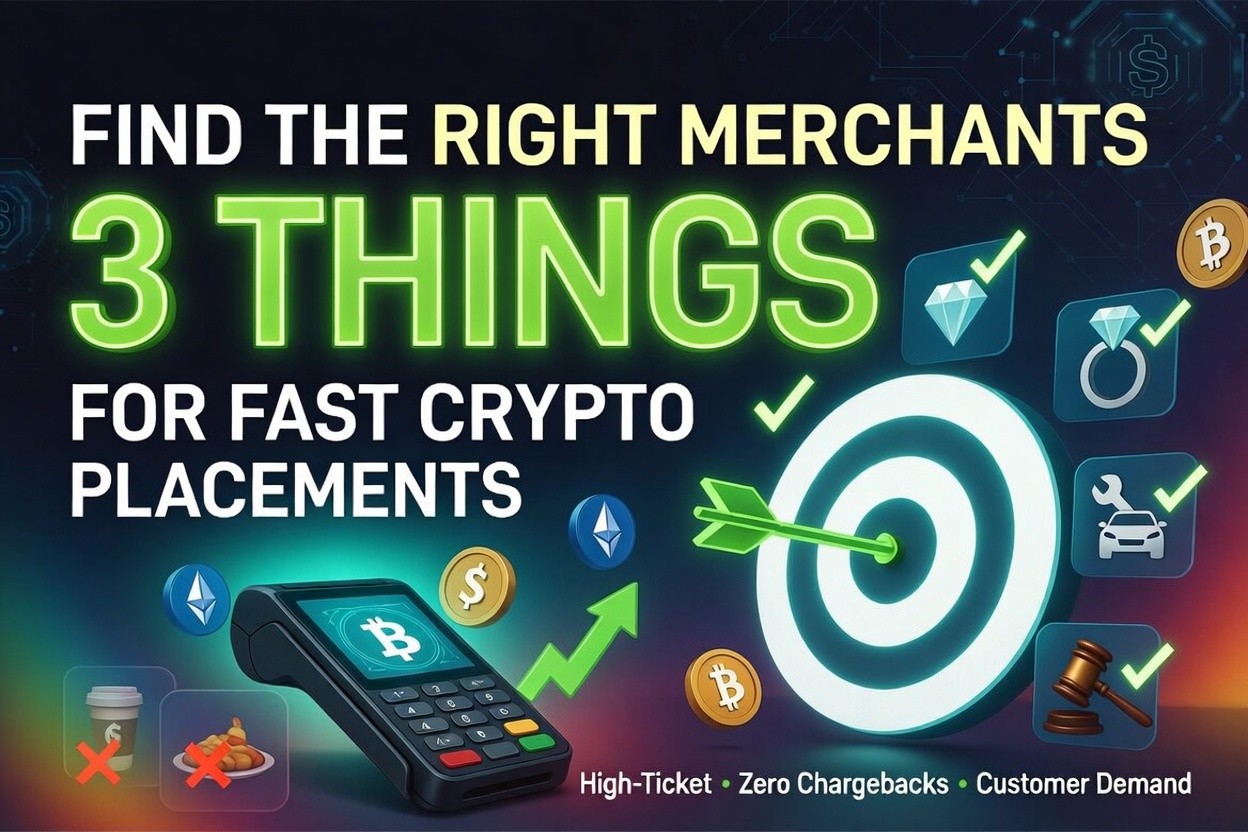
The merchants who convert fast share a specific profile. Three traits, not ten. Once you can identify all three in the first 90 seconds of a conversation, you know whether you're talking to a fast yes or a long education project.
This article explains the targeting logic so any business in any market can be evaluated on the spot — not just the category names, but the underlying criteria that produce placement-ready conversations.
The Three Traits That Predict a Fast Placement
Trait 1: They're already bleeding processing fees.
Traditional credit card processing costs merchants between 1.5% and 3.5% per transaction, all-in. Premium rewards cards — the kind your highest-spending customers carry — push that to 4.5% to 6%. The National Retail Federation calls processing fees most merchants' highest operating cost after labor.
For a low-ticket, high-volume business like a coffee shop, a 3% processing fee is a rounding error on a $5 transaction. It's annoying, but it doesn't keep the owner up at night.
For a merchant processing high-ticket sales — $500, $1,000, $3,000 — the math changes completely. At 3% on a $2,000 transaction, the processor takes $60. On a $5,000 service invoice, that's $150. These merchants feel the fee on every single sale, because the dollar amount is large enough to register as real money.
That pain is the opening. On a $2,000 transaction, BitPay's rate of 1% plus $0.25 costs $20.25 — a 65% reduction from the standard card rate. You're not asking a merchant to try something new for its own sake. You're showing them $40 they're currently giving to their card processor on every comparable sale.
Trait 2: Chargebacks are a real operational problem for them.
Chargebacks cost U.S. merchants $117.47 billion in 2023. The average chargeback rate across industries sits at 0.60%, with card-not-present transactions running higher. For every dollar lost to fraud, merchants absorb $4.61 in total costs when fees, labor, and lost goods are factored in. Merchants win only 8 to 18% of the disputes they contest.
The merchants who feel this most acutely aren't necessarily the ones with the highest raw chargeback volume. They're the ones where a single disputed transaction causes disproportionate pain.
An auto repair shop where a customer disputes a $1,400 transmission job six weeks after driving the car off the lot. A jeweler where a buyer claims a $2,800 ring was never received. An attorney whose client reverses a $4,000 retainer after the work is done. Each of these situations involves not just the dollar loss — but the time, paperwork, and almost certain defeat in the dispute process.
Crypto transactions are irreversible by design. Once confirmed on the blockchain, no bank, card network, or third party can reverse the payment. The merchant who issues a refund does so voluntarily. The decision belongs to them — not to a customer calling their card issuer two weeks later.
For any merchant where a chargeback isn't just an inconvenience but a genuine business event, that's the conversation you lead with. Not fees. Not crypto. Settlement finality.
Trait 3: Their customers are already asking.
The NCA/PayPal survey of 619 payment decision-makers found that 88% of merchants already receive customer inquiries about paying with crypto. Sixty-nine percent say those requests come in at least monthly.
The merchant who has already been asked by customers isn't being introduced to a concept. They already know the demand exists. They've just never been handed a simple way to say yes.
When all three traits are present — fee pain, chargeback exposure, and existing customer demand — the conversation moves fast. You're not pitching. You're solving a problem the owner already knows they have.
The Categories Where All Three Converge
Understanding the traits is the framework. The categories are just where those traits concentrate.
Independent Jewelry and Luxury Retail
This is the single highest-converting category for a reason.
Average ticket sizes run $500 to several thousand dollars. At that level, a 3% card processing fee is a real dollar amount on every transaction — not a rounding error. A merchant paying 2.9% on a $3,000 jewelry sale is handing $87 to their processor on one transaction.
Chargeback exposure is severe. A customer who disputes a high-ticket purchase — claiming a piece wasn't as described, or that a custom order was wrong — puts the jeweler in a near-impossible position with the card network. The dollar stakes are high and the merchant's win rate is low.
The customer base overlap is the third piece. BitPay's average transaction reached $390 in 2025, with one in five transactions going toward luxury goods. Crypto spenders are not a different demographic than jewelry buyers — they're largely the same people. Higher-income, financially sophisticated, comfortable transacting with non-traditional methods.
Walk in with the processing fee math and the chargeback story. The conversation rarely requires a third visit.
Auto Repair — Independent Shops, Not Chains
Independent auto shops process $500 to $3,000 transactions with owners who typically manage their own books. They feel the processing fee personally, not through a corporate finance department.
Chargebacks are a known operational hazard in this category. A customer who disputes a large repair job weeks after completing — claiming the problem wasn't fixed — forces the shop into an adversarial process they usually lose. The card network's dispute resolution doesn't evaluate the quality of the repair work. It processes the claim.
The demographic alignment also holds. Auto shop customers skew male, 30 to 55, and are increasingly crypto-aware. The average $800 crypto transaction size matches cleanly with the repair ticket range.
Zero chargebacks is not a secondary benefit in this vertical. It's the primary pitch.
Legal and Professional Services
Attorneys, accountants, consultants, financial advisors — anyone issuing invoices for $1,000 to $10,000-plus of completed professional work.
The chargeback dynamic here is acute in a specific way. Professional services are often delivered before payment clears. A client who reverses a $5,000 legal retainer after the work is completed isn't just a financial loss. It's a dispute the attorney will almost certainly lose, because the card network evaluates the mechanics of the transaction, not the quality of the representation.
Crypto payment settlement is irreversible. For a solo practitioner or small firm where one disputed invoice represents a meaningful share of monthly revenue, that feature is not a novelty. It's protection.
Forrester's research found that up to 40% of crypto-paying customers were net-new to the merchant. In professional services, one net-new high-value client can pay the residual value of a terminal many times over.
Cannabis-Adjacent and Specialty Retail
Dispensaries, CBD and hemp retailers, and other businesses in the cannabis-adjacent space have a processing problem that goes beyond fee percentages.
Many traditional payment processors either refuse to serve these merchants entirely, offer limited services at punitive rates, or regularly suspend accounts without notice. The merchant has limited options, unreliable infrastructure, and no chargeback leverage even when they're in the right.
Crypto payment acceptance isn't just a cost savings conversation in this category. It's a structural solution to an infrastructure gap they've been living with.
The conversation doesn't start with "have you considered crypto." It starts with "what's your current processing situation?"
Medical Aesthetics, Med Spas, and Specialty Health
High-ticket elective procedures — cosmetic treatments, specialty wellness services, concierge health — share a profile that makes them predictable targets.
Average transaction sizes are meaningful. Chargeback exposure is real; a client who disputes a $2,500 procedure claim can be a difficult situation even when the service was delivered exactly as described. And the owner demographic in this category — typically an entrepreneurial operator in their 30s or 40s who manages the business personally — is more accessible than a corporate franchise manager.
The younger owner running a med spa or specialty wellness business is often personally familiar with crypto. The conversation starts at a different baseline than it does with a 65-year-old dry cleaner who's been processing cards the same way for 30 years.
Why the "Friendly" Business Is Usually the Wrong First Call
There's a predictable mistake early-stage partners make: they target the businesses they already know.
The neighborhood coffee shop. The restaurant where they eat lunch. The gym they're a member of. These feel like easier conversations because there's an existing relationship. They're not easier. They're just more comfortable.
Most of these businesses process low average tickets and run high transaction volume. The processing fee on a $12 lunch is less than $0.40. Chargebacks are rare and low-dollar when they happen. The owner isn't lying awake thinking about their Visa bill.
There's no live pain to connect to. The conversation has to create interest from scratch. That's a longer sales cycle — not because the technology isn't right for them, but because you haven't walked in to solve a problem they were already trying to solve.
Start with pain. Find the merchants who already have the problem. The coffee shop can come later, after you have five placements and a local success story to point to.
A Practical Filter for Any Business You're Evaluating
Before approaching any merchant, run them through these three questions.
Is the average transaction above $200? Below that threshold, fee savings are real but not dramatic on a per-transaction basis. Above it, the dollar math starts to move a business owner.
Has the owner expressed frustration with their processor, mentioned a chargeback, or had customers ask about paying with crypto? Any one of these indicates an open door. All three means the conversation is already half over before you walk in.
Does the owner manage their own books? A business owner who feels processing fees personally — not through a corporate finance department three steps removed — converts faster. They know exactly what they're paying. They feel every dollar.
If the answer to all three is yes, it's a priority call.
If the answer to two is yes, it's a second-tier target worth pursuing once the priority list is worked.
If the answer is one or zero, put it in the long-cycle category and focus elsewhere first.
The targeting framework doesn't make the placement work easier. It makes it more efficient. You spend the same number of conversations — but more of them end in a signed location because you walked into the room with a solution to a problem the merchant already had.
That's the difference between sales and order-taking. Find the pain first. Then show up with the answer.