
Published on:
Is Crypto Payment Processing an MLM? Here's the Structural Difference

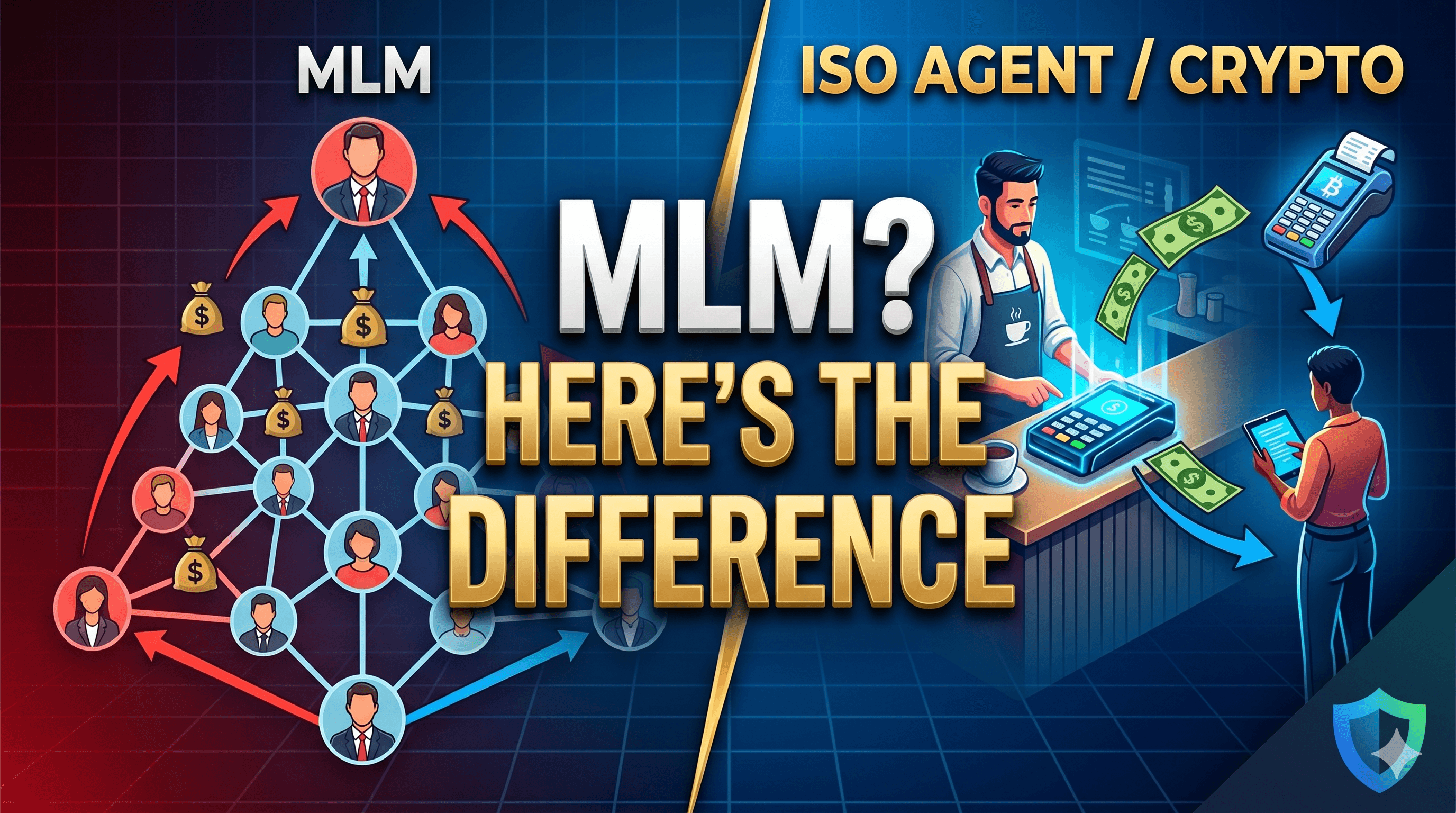
The question comes up every time someone serious starts looking at this model.
"Is this an MLM?" "Is Dividend Shift a pyramid scheme?" "Am I going to end up pitching this to my friends and family?"
These are not insulting questions. They are reasonable questions. Anyone who has been burned by a network marketing company — or watched a colleague get burned — is right to ask them before they move forward with anything that involves income from placing a product or service.
This post answers the question directly. Not with reassurances. With the actual structural comparison, side by side, using the legal definitions and the documented compensation architecture.
If it's an MLM, you'll be able to see it in the structure. If it's not, you'll be able to see that too.
What the FTC Says an MLM Actually Is
The Federal Trade Commission has a clear definition. An MLM — also called a multi-level marketing company, network marketing company, or pyramid scheme when the structure is fraudulent — has one identifying feature above all others.
The income is generated primarily by recruiting, not by selling.
More specifically, the FTC's framework identifies the following structural elements as defining MLM compensation:
Participants earn commissions not just on their own sales, but on the sales of people they recruit — and on the sales of people those recruits bring in. The compensation structure has multiple tiers, with money flowing upward from each layer to those above it. In the worst versions, the product or service is secondary, and the primary mechanism for income is recruiting the next wave of participants.
The FTC's 1979 ruling in In re Amway Corp. established a baseline legal test: a business is not an illegal pyramid if the income primarily derives from selling products or services to end-user customers rather than from recruiting new distributors. The critical question in every MLM investigation is the same: where does the money actually come from?
Product sales to real customers: potentially legitimate.
Money generated by recruiting the next participant: structurally fraudulent, regardless of what's being sold.
That's the test. Keep it in mind as we look at what the ISO model actually is.
What an ISO Agent Is — and How Long This Model Has Existed
ISO stands for Independent Sales Organization. It is a registered third-party company or agent that sells and manages merchant payment processing accounts on behalf of licensed payment processors.
The ISO/agent model has governed how payment processing agents earn income for approximately 40 years. Visa, Mastercard, American Express, and every major card network operate through it. Every time a local business signed up for a credit card terminal in the 1980s, 1990s, and 2000s, there was likely an ISO agent behind that placement — earning a residual on every transaction that merchant processed from that day forward.
The compensation mechanism works like this.
When a business accepts card payments, it pays a processing fee — typically between 2.5% and 3.5% of each transaction. That fee is divided across several parties: the issuing bank takes the largest share through interchange fees (roughly 1.5% to 2.1%), the card network takes its assessment (around 0.13% to 0.15%), and the processor takes a markup — roughly 0.2% to 0.5% plus a per-transaction fee. The ISO agent earns a portion of that processor markup for the life of the merchant account.
Velocity Funding published a concrete example. A business called Barry's Donuts processes $20,000 per month in card sales at a 2.75% flat rate. Total processing fees: $550 per month. The agent's cut of the markup: approximately $50 per month. That $50 arrives every month — whether the agent does any work that month or not — for as long as Barry's Donuts keeps processing.
Industry-standard agent residual splits run 25% to 70% of the markup profits. Shaw Merchant Group publishes agent agreements with splits up to 70%.
Beacon Payments describes their most established agents plainly: "Some of our reps have not written a deal in five years yet continue to earn money through their recurring residual stream every single month."
That is the ISO model. The income source is transaction volume from merchants the agent placed. Not recruitment. Not the fees paid by the next agent. Transaction volume.
The crypto payment terminal model is structurally identical. Instead of credit card processing fees, the residual comes from crypto payment processing fees — typically 0.5% to 1% of transaction value. The agent places a terminal at a merchant location. The merchant processes transactions. The agent earns a residual percentage of each one, indefinitely.
The Structural Comparison
Here is the direct side-by-side.
What triggers income in an MLM: Recruiting a new participant. That new participant's entry fee, product purchase, or recruitment of others flows upward through the compensation tiers.
What triggers income in the ISO/crypto terminal model: A customer at a merchant location completes a payment transaction. The processing fee is collected. The agent receives their residual percentage of that fee.
Income source in an MLM: Other participants in the distribution network.
Income source in the ISO model: End-user customers making real purchases at real businesses.
Compensation tiers in an MLM: Multiple. Your recruits earn you money. Their recruits earn you money. The structure grows upward with each layer.
Compensation tiers in the ISO model: One. The agent earns a residual from the merchants they personally placed. Not from merchants placed by anyone they referred. Not from any downstream network.
Who pays in an MLM: Primarily the participants — through required product purchases, starter kits, enrollment fees, and ongoing purchase quotas.
Who pays in the ISO model: The merchant's customers, through transaction fees embedded in the payment processing rate. The merchant pays the processing fee. The agent earns a fraction of it. No participant is paying anything to generate anyone else's income.
What happens if you never refer anyone: In a pyramid scheme or MLM, your income potential is severely limited without recruitment because recruitment is the primary engine.
In the ISO/crypto terminal model: nothing happens to your income. Your residuals from your placed merchant accounts are unaffected. If you place 20 terminals at 20 businesses and never refer another agent to the program, you earn residuals on those 20 accounts every month for as long as those merchants process transactions. Referral activity is irrelevant to the income calculation.
The Recruitment Question Specifically
This is the part that matters most, so it gets its own section.
Some business models that use agent-based distribution do offer referral bonuses or commissions for introducing new agents to the system. That exists in traditional ISO structures as well. A senior agent who trains and sponsors a new agent sometimes earns an override — a small percentage of what the new agent produces.
That is not an MLM structure. It is a standard sales management override, the same mechanism that has governed sales team compensation in insurance, financial services, and merchant services for decades. The key distinction is what the override is calculated on.
In a legitimate agent model: the override is calculated on the merchant transaction volume the new agent generates by placing accounts. Real sales. Real customers.
In an MLM: the override is calculated on what the new recruit pays into the system — their starter kit purchase, their monthly product quota, their own recruitment activity.
The income source is the test. Every time.
In the crypto payment terminal model, whether you refer another agent or not, your income comes from one place: the transaction volume processed at the merchant locations you placed. A new agent you referred does not pay you anything. They do not buy anything from you. Their activity does not trigger a commission to you based on their enrollment or their purchases.
If their merchant placements generate transaction volume, and if the compensation structure includes a small override for the referring agent based on that volume — that is a sales management structure. Not an MLM.
The difference is not semantic. It is structural, measurable, and directly visible in the compensation agreement.
The Regulatory Layer That Governs This
MLM structures and fraudulent pyramid schemes are regulated and prosecuted by the FTC. They are unregistered, unregulated compensation structures that depend on ongoing recruitment to sustain the income of participants near the top.
The ISO model operates under a different regulatory framework entirely.
Licensed payment processors are registered with FinCEN — the Financial Crimes Enforcement Network — as Money Services Businesses. They operate under Bank Secrecy Act compliance requirements, AML protocols, and federal oversight. Circle, which issues USDC and operates core stablecoin payment infrastructure, is registered with FinCEN as a money transmitter in 48 U.S. states and operates under MiCA compliance in Europe.
The GENIUS Act, signed July 18, 2025, and passed with bipartisan support — 68 to 30 in the Senate, 308 to 122 in the House — established the first comprehensive federal framework for digital payment stablecoins. It mandates 1:1 reserve backing, monthly independent audits, AML compliance, and explicit federal regulatory classification of payment stablecoins as neither securities nor commodities.
The OCC has granted conditional national trust bank charters to BitGo, Circle, Fidelity Digital Assets, Paxos, and Ripple. These are federal banking-level regulatory designations. They do not describe fringe or unregulated operations.
An agent placing crypto payment terminals under a licensed processor's regulatory umbrella is operating within a framework governed by FinCEN, the GENIUS Act, OCC-supervised issuers, and standard ISO compensation law. That framework does not describe an MLM. It describes a federally supervised payment processing agent structure.
Why the Confusion Happens — and What It Reveals
The confusion between the ISO model and an MLM is understandable for one reason: both involve agents, both involve residual income, and both are sometimes pitched in ways that emphasize the income opportunity rather than the underlying mechanism.
A bad pitch for a legitimate ISO opportunity can sound indistinguishable from an MLM pitch if the presenter emphasizes income projections, passive lifestyle, and referral income without explaining the structural mechanics. That's a presentation problem. It doesn't change the underlying structure.
The way to evaluate any income opportunity is not to listen to the pitch. It is to read the compensation document and ask a single question: where does the money come from?
If the answer is transaction volume from end-user customers at real businesses, you are looking at a merchant services model — the same model that has governed the $2.4 trillion global payments industry for four decades.
If the answer is recruitment, enrollment fees, or the purchases of participants, you are looking at an MLM.
Those two answers describe completely different businesses. The structure does not lie.
That is a 40-year-old business model that Visa, Mastercard, and every ISO agent in America has been operating under since the first POS terminals went into restaurants and retail stores.
The crypto version is newer. The underlying structure is not.
The Dividend Shift Team builds and supports the next generation of crypto payment infrastructure businesses. Founded by former U.S. Marine and Oakland Police Sergeant Gedam Tekle, with two eight-figure exits, the team has helped over 4,000 entrepreneurs place passive income streams into local markets across the country.