
Published on:
Is It Too Late to Get Into Crypto Payment Processing? Here's What the Data Actually Says

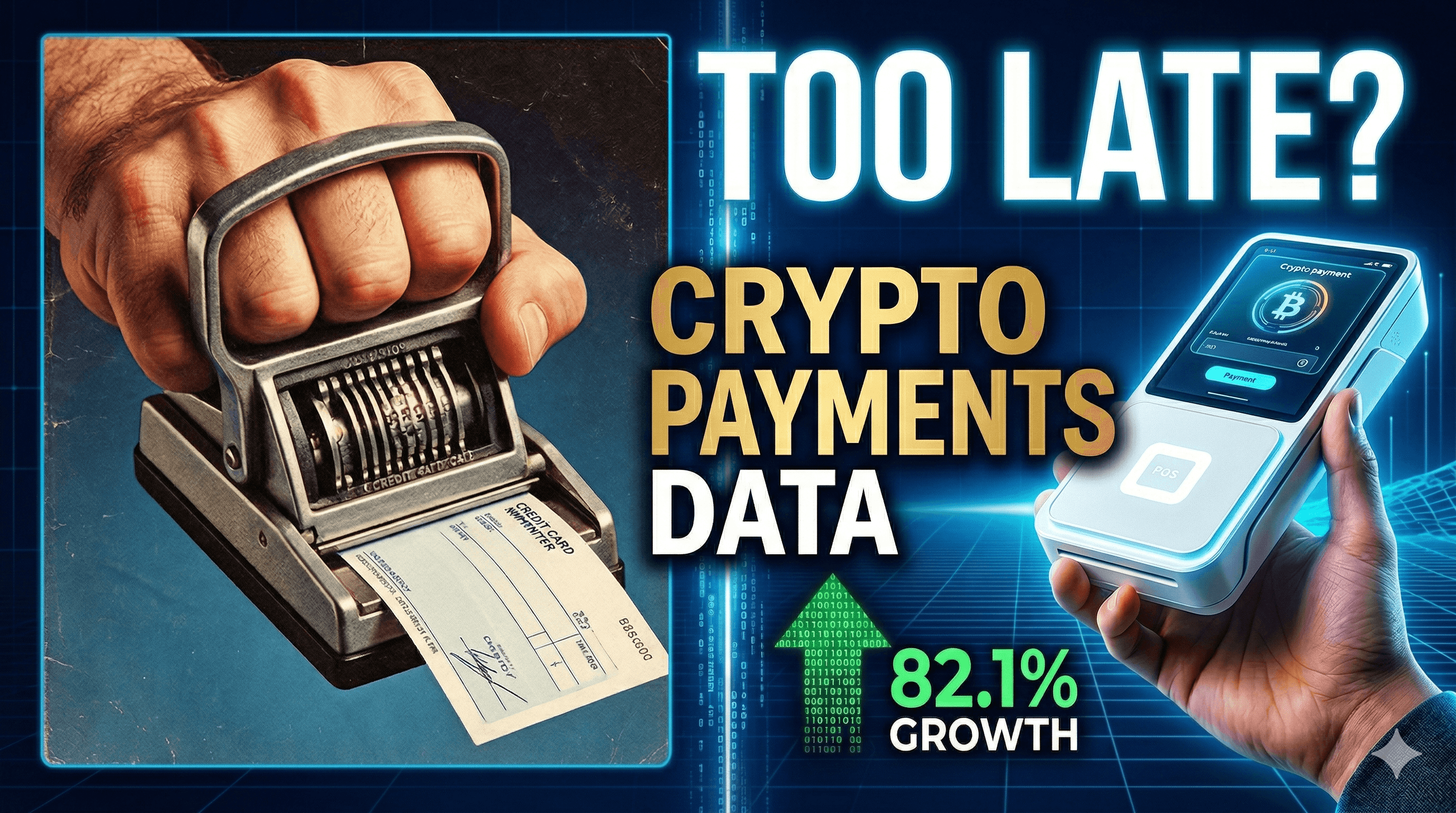
Is It Too Late to Get Into Crypto Payment Processing? Here's What the Data Actually Says
Most people ask the timing question the wrong way.
They ask whether they "feel" ready. Whether the opportunity still "seems" real. Whether the window is still open or already closed.
This article answers a more useful version of the question: what does the data actually say about where crypto payment processing sits on the adoption curve in early 2026, and how does that compare to the moments in history that created generational wealth for people who moved early?
The numbers are specific. Draw your own conclusion.
What "Too Late" Means
Too late means the market is saturated.
Every merchant who would say yes has already said yes. Every territory is claimed. Every dollar of residual income is already flowing to someone else.
Here is how far we are from that.
Approximately 70 million Americans own cryptocurrency right now. That's 30% of all U.S. adults — roughly the same share of the population that owns a dog.
How many U.S. businesses currently accept crypto at the local level?
Approximately 2,300.
Crypto.com's tracking puts the number of U.S. businesses accepting Bitcoin directly at around 2,300. Against 33.2 million U.S. small businesses, that's a penetration rate below 0.01%.
Run the ratio: roughly 24,000 crypto holders for every accepting business.
That is not a saturated market.
That is a market where the demand exists and the infrastructure doesn't.
The 1982 Parallel Is Real — And the Math Backs It Up
In 1979, Visa introduced the first electronic point-of-sale terminal.
In 1983, Verifone released the ZON — the device most payment historians consider the first modern credit card terminal.
Through most of the early 1980s, the majority of American merchants still ran manual imprinters. Carbon-copy slips.
A phone call to verify the card. The knuckle-buster.
The people who placed electronic terminals during that window — roughly 1982 to 1995 — built merchant relationships and geographic territories that compounded in value over two decades.
As consumer spending shifted from cash to cards, the residuals from those early placements grew with the volume through those merchants. Placing 100 terminals in 1985 translated to substantial passive income by 1995 — not because the agent did anything more, but because the overall volume grew as card usage became universal.
By 1999, terminal penetration was near-universal. The window to capture a territory was effectively closed.
Here is where crypto payment processing sits on that same timeline right now: approximately 1982 to 1985.
The technology works. The infrastructure exists. The regulatory framework passed into law in July 2025.
But mass merchant deployment hasn't happened. Crypto's share of total U.S. payment volume sits at approximately 2%. There are an estimated 4.9 million active crypto payers in the United States.
Compare that to the hundreds of millions of active card users — and the position on the adoption curve becomes clear.
The Data Points That Define the Window
The case that the window is open right now comes from specific numbers.
Crypto payment volume is growing at 82.1% from 2024 to 2026 — but from a base of 2% market share. That means absolute transaction numbers are still small enough that independent agents can move meaningfully in local markets before the institutional players arrive at every merchant's door.
The NCA/PayPal survey of 619 payment decision-makers found 88% of merchants already receive customer inquiries about paying with crypto. 69% say those requests arrive at least monthly.
The demand exists at the local level.
The merchant hasn't said no to crypto. They just haven't had a clear path to say yes.
True local small business penetration is a fraction of published adoption figures, which skew toward large enterprises.
The barbershop, the auto shop, the dental office, the local jeweler — most of them have no solution in place.
The case that the window is closing comes from equally specific numbers.
PayPal launched "Pay with Crypto" for U.S. merchants in July 2025. Square Bitcoin launched in November 2025, bringing Bitcoin payment capability to 4 million merchants with zero processing fees through 2027. Stripe partnered with Crypto.com in January 2026. Visa's stablecoin settlement hit a $3.5 billion annualized run rate — up 460% year-over-year.
These are not early signals. These are full institutional commitments.
Chris McGee of AArete stated plainly: the first wave of stablecoin innovation and scaling will really happen in 2026.
Leonid Bashlykov of Revolut: 2026 is going to be massive.
The consensus estimate among analysts tracking this market closely is 12 to 24 months before institutional rollout makes independent placement a commoditized afterthought rather than a first-mover advantage.
Why First Movers Win in Payment Processing Specifically
In most industries, the first-mover advantage is overstated.
Markets are large. Customers switch. A better product can always take share.
Payment processing is different. The reason is switching costs.
Once a merchant has a terminal installed, integrated into their system, and familiar to their staff, they don't switch.
The friction of changing payment processors is real: new hardware, new staff training, new software integrations, potential downtime during the transition, a relationship to rebuild.
The industry standard is that merchants stay with their processor for years. Often a decade or more.
That means the merchant locked in today is a residual income stream that persists.
And every merchant placed is one fewer merchant available for the next agent who enters the same territory.
This is exactly what happened in credit card processing. Agents who placed terminals in the mid-1980s built positions that competitors couldn't dislodge even when better products entered the market — because the switching cost protected the relationship.
The income compounded. The territory held.
The Honest Risk: First Movers Don't Always Win
The data cuts both ways.
First movers fail at a rate of about 47%, according to ITONICS innovation research.
Early followers — those who enter after proof of concept but before mass adoption — capture 28% market share with only an 8% failure rate.
That framing actually strengthens the case for moving now rather than undermining it.
Crypto payment processing is past proof of concept. PayPal, Square, Stripe, and Visa entering the market simultaneously is not a threat to the early mover — it is the proof of concept the early mover needed. Trillion-dollar companies moving in don't invalidate the opportunity. They confirm the direction of travel.
The sweet spot in any technology adoption curve is precisely where crypto payments sit in early 2026: after the technology has been proven to work, after the regulatory framework has been established, and before mass adoption has saturated the market.
Too early is 2015 — when the infrastructure wasn't reliable and the regulatory environment was openly hostile.
Too late is 2028 — when PayPal has made crypto acceptance a default checkbox on 29 million merchant dashboards.
What the Next 18 Months Look Like
The GENIUS Act's full regulatory implementation completes in approximately November 2026. During this period, stablecoin infrastructure is being built and merchant adoption is accelerating from a small base. Independent agents have meaningful runway to establish territory before institutional rollout reaches the local level.
In 2027, PayPal's target of 20 million active crypto merchant accounts starts to materialize. Square's zero-fee Bitcoin period ends and reverts to 1% processing — still competitive with traditional card fees, but the independent agent's window for first-mover positioning in local markets is meaningfully narrower.
By 2028 and beyond, crypto acceptance becomes a standard checkbox in every major POS system. The independent agent's value proposition shifts from education and installation toward ongoing relationship management.
The agents who move in 2026 lock in merchant relationships and territory while those relationships are still available to lock.
The technology works.
The law passed.
The direction is confirmed.
What remains is the question of whether the data supports moving before the opportunity normalizes.
For crypto payment processing in early 2026, it does.
The Dividend Shift Team builds and supports the next generation of crypto payment infrastructure businesses. Founded by former U.S. Marine and Oakland Police Sergeant Gedam Tekle, with two eight-figure exits, the team has helped over 4,000 entrepreneurs place passive income streams into local markets across the country.