
Published on:
The IRS Accidentally Made the Case for Crypto Payment Infrastructure

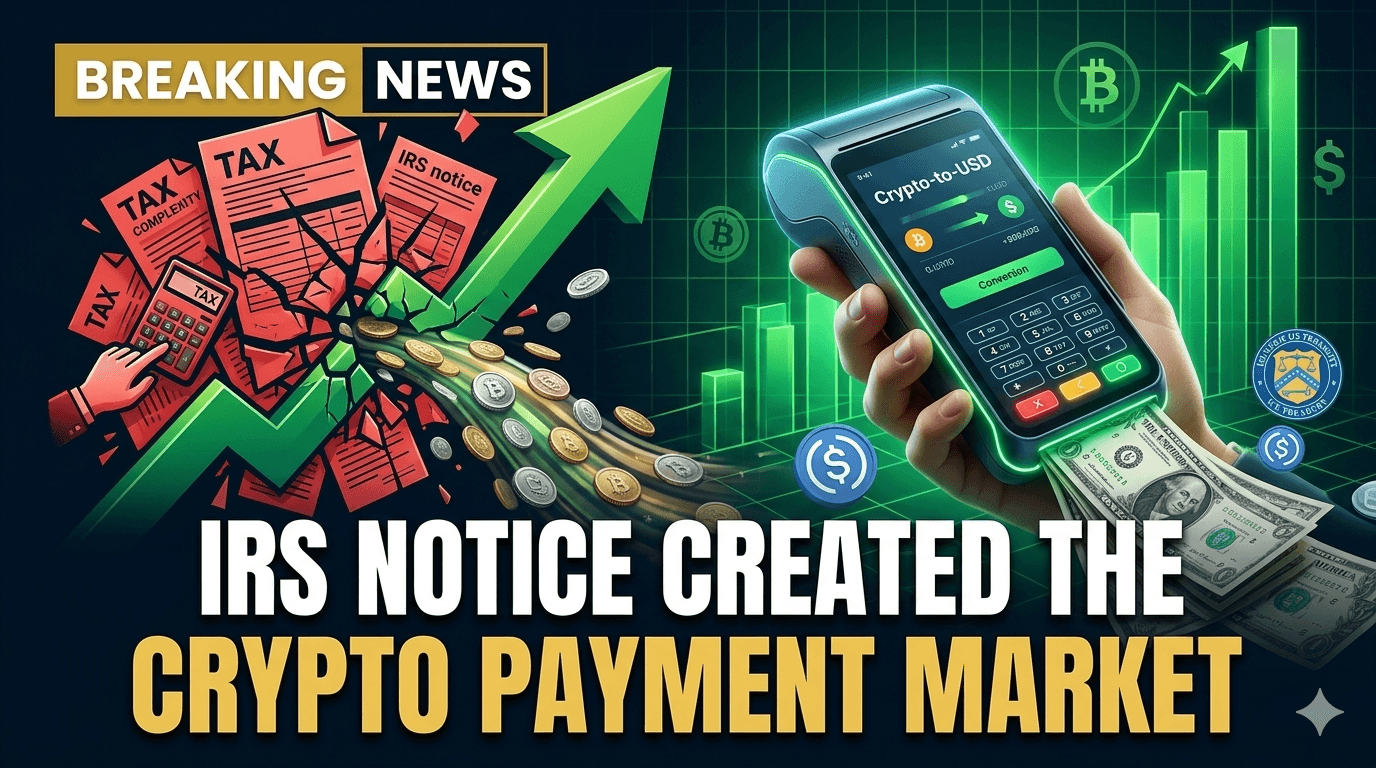
The most common argument against crypto as a practical payment method is also the most honest one.
It's not volatility.
It's not complexity.
It's taxes.
When the IRS classified cryptocurrency as property in 2014 — not currency, property — it created a specific problem.
Every time you spend crypto, you trigger a potential capital gains event. You bought Bitcoin at $30,000. Now it's worth $90,000. You use some of it to pay for a car repair. Technically, you just realized a gain on that portion, and you owe tax on it.
That's not a rumor. That's IRS Notice 2014-21. It's been the law for over a decade.
Critics use this as a knockout argument. If every transaction is a taxable event, nobody will ever actually spend crypto. The friction kills it as a payment method. Game over.
They're right about the friction.
They're wrong about what the friction means.
What the IRS Actually Created
Think about what the tax treatment problem requires in order to be solved.
The customer doesn't want to calculate a capital gain every time they buy lunch. So they need a system that removes that burden — one that converts their crypto to USD at the moment of payment, so the event is discrete, measurable, and handled automatically rather than requiring them to track basis across dozens of small transactions.
The merchant doesn't want to hold crypto either. Not because of taxes — because of volatility, complexity, and the fact that they're running a restaurant or an auto shop, not a cryptocurrency fund. They need to receive dollars.
Both parties, independently, need exactly the same thing: a system that converts crypto to USD at the point of
transaction, instantly, and takes the complexity off both of their plates.
That system is the payment processor.
The IRS didn't kill crypto payments. It created the demand for the exact infrastructure layer that makes crypto payments function at scale — and made that infrastructure layer indispensable to both sides of the transaction.
That is not a bad position to be in if you're the one building the infrastructure.
How the Problem Gets Solved in Practice
The way modern crypto payment processing works is worth explaining precisely, because it's the mechanism that resolves the tax argument.
When a customer initiates a payment at a crypto terminal, the processor does two things simultaneously: it generates a unique payment address for that transaction, and it locks in the exchange rate at that exact moment.
The customer sends crypto. The processor converts it to USD at the locked rate. The merchant receives dollars. The entire window between crypto and cash — the window where price movement could matter — is measured in seconds.
BitPay's documentation is explicit: the merchant generates the invoice in their local currency, and the customer pays at a locked-in exchange rate. Coinbase Commerce describes it the same way: automatic conversion to USDC at the time of payment, volatility-free. The merchant experience is functionally identical to accepting payment from a foreign customer. The tourist pays in euros, the network converts it, the merchant sees dollars. Nobody considers that "holding euros."
For stablecoins — USDC, USDT, and others pegged 1:1 to the U.S. dollar — the conversion isn't even necessary. One USDC equals one dollar by design, backed 1:1 by cash and short-term U.S. Treasuries, with monthly independent audits published by Deloitte. When the GENIUS Act was signed in July 2025, payment stablecoins were explicitly classified as neither securities nor commodities — a federal legal confirmation that digital dollars designed for transactional use are in a separate category from speculative assets.
The infrastructure handles the complexity. Both parties get what they actually wanted. The friction dissolves.
The Part Nobody Talks About
Here's the angle that most crypto commentary misses entirely.
The 90% figure from the NCA/PayPal survey is the one that matters: 90% of merchants said they would accept crypto if they could convert instantly to fiat. Not 40%. Not 60%. Ninety percent.
That number doesn't describe a population of skeptics who need to be converted. It describes a population that already wants to say yes, is already being asked by customers, and is being held back by a single structural problem — the complexity of managing a payment method that requires them to understand and hold a volatile asset.
Modern payment infrastructure eliminates that problem entirely. Which means the 90% are a yes waiting to happen, not a no waiting to be overcome.
The IRS's property classification created the friction. The friction created the demand for processors. And the demand is sitting in 90% of merchant conversations, already there, already identified, waiting for someone to show up with the infrastructure to resolve it.
That's the business.
"But What About the Customer's Tax Problem?"
This is the fair follow-up, so let’s address it directly.
The customer's tax burden is real. Spending crypto and calculating gains on each transaction is genuinely inconvenient, and for someone spending frequently, it adds up to meaningful complexity. That friction reduces how much people spend crypto on everyday purchases.
But notice what it doesn't reduce.
It doesn't reduce high-ticket discretionary spending, where the transaction is significant enough to be worth tracking and the customer is sophisticated enough to handle the accounting. BitPay's average transaction in 2025 was $390.
One in five was a luxury goods purchase. These aren't impulse buys at a convenience store. These are deliberate transactions from buyers who have already decided the asset is worth spending and the complexity is worth managing.
It doesn't reduce stablecoin spending, because a stablecoin that was always worth $1 has no capital gain to calculate.
The tax problem doesn't exist for USDC in the way it exists for Bitcoin. As stablecoin adoption grows — retail stablecoin transactions rose over 125% between the first three quarters of 2024 and the same period in 2025 — the tax friction argument applies to an increasingly smaller slice of crypto transaction volume.
And it doesn't reduce the demand from 70 million American crypto holders who already own the asset and are actively looking for places to spend it. 88% of merchants are already being asked. The demand is there despite the friction. Which is what demand looks like when it's real.
Why This Is the Argument That Closes Skeptical Merchants
We've had this conversation hundreds of times. The merchant who's been burned on complexity before, who doesn't want to add anything to their operation that creates accounting headaches, who asks the smart question: "What do I do with taxes on all these crypto transactions?"
The answer is simple and it's accurate: they don't have a crypto transaction. They have a dollar transaction. The customer paid in crypto. The infrastructure converted it. The merchant received dollars. Their books look exactly like any other sale.
That's not a workaround. That's how the system is designed to work. The processor absorbed the conversion. The merchant's accounting sees fiat.
And when a skeptical merchant understands that — really understands that the complexity lives inside the infrastructure layer, not on their P&L — the conversation changes.
The IRS created a problem that made both sides of every crypto transaction want a middleman who could make it disappear. That middleman earns a residual on every transaction processed, indefinitely, from the merchants who placed their infrastructure. And the demand for that middleman exists because of a 2014 IRS notice that most people read as an argument against crypto payments.
Read it right, and it's the business case.
It doesn’t require you to understand crypto tax law. It requires you to understand that friction creates markets, and the person who resolves the friction earns from the volume.
The Dividend Shift Team supports partners building residual income through crypto payment terminal placement. Dividend Shift was founded by Gedam Tekle, a former U.S. Marine and Oakland Police Sergeant who has personally exited two eight-figure companies and helped over 4,000 entrepreneurs build infrastructure-based businesses.