
Published on:
What a Barbershop, Auto Shop, and Dental Office Earn From a Crypto Terminal Per Month

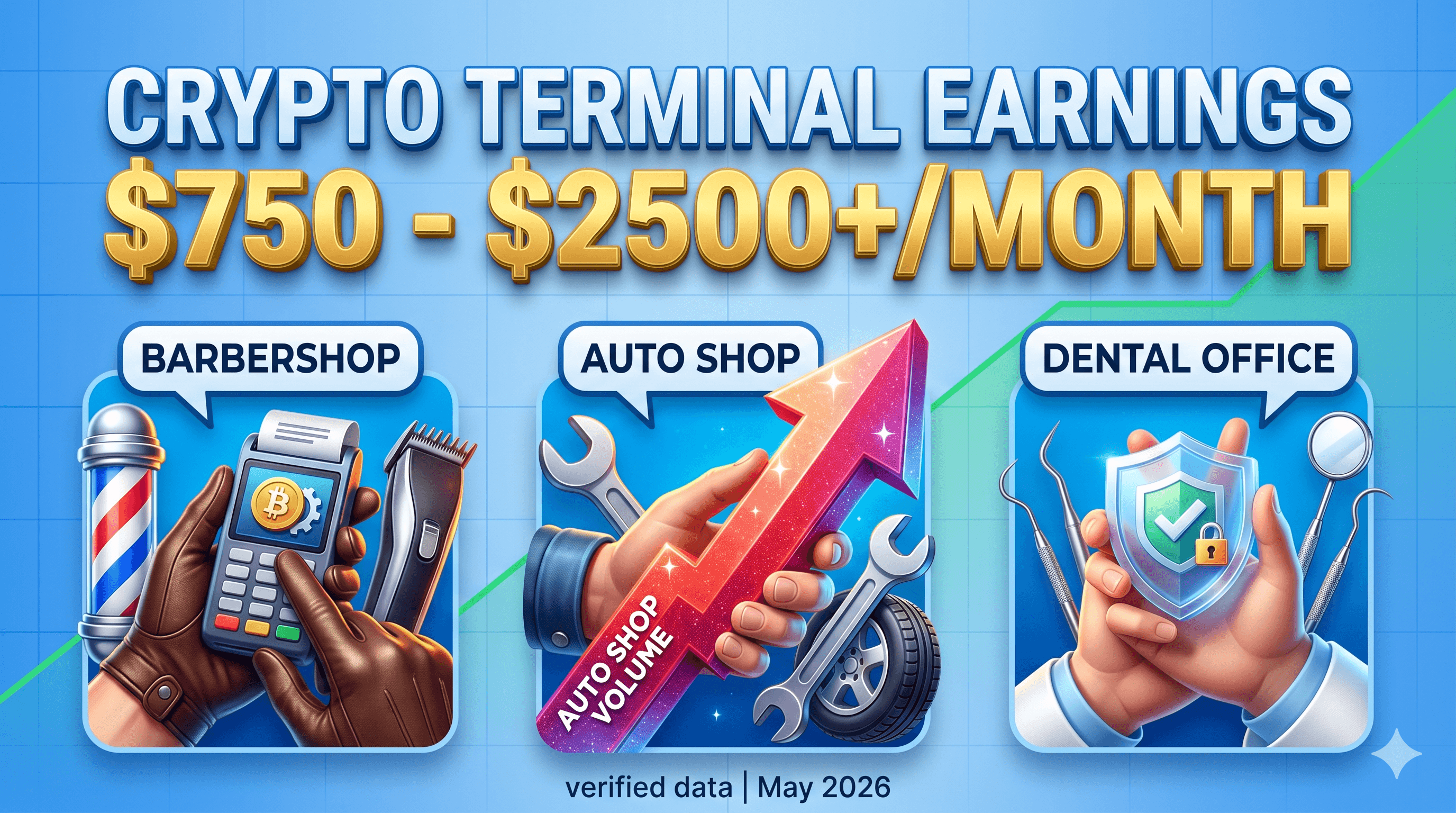
Quick Answer: Income per terminal varies significantly by merchant type. An auto shop processing $40,000/month in crypto transactions generates roughly $200–$400/month in residual income. A dental office at similar volume produces $100–$500/month. A barbershop typically falls in the $75–$250/month range. A dispensary (where legal) can produce $250–$1,500/month. A portfolio of five mixed locations realistically generates $750–$2,500/month in combined residuals.
The general income math for crypto payment terminal placement has been covered — how the residual structure works, what a portfolio generates at 10 or 20 locations, what the ceiling looks like at scale. That post is useful for understanding the model.
This one answers a more specific question: what does a single location at a specific business type actually earn you per month? Because not all merchants are equal. The volume varies by category. The customer demographics vary. The average ticket size varies. All of it affects your monthly residual from a single placement.
Here's what the math actually looks like by merchant type.
Which Types of Businesses Make the Best Locations for Crypto Terminals?
The short answer: high-ticket, owner-operated businesses where the customer skews 30–50, male, and financially independent.
That profile lines up with what the ownership data shows. Security.org's 2026 survey found that 30% of American adults — roughly 70 million people — now own cryptocurrency, and one in three of those owners falls in the 30–44 age bracket. BitPay's 2025 transaction data found an average transaction size of $390, with one in five transactions going toward luxury goods.
The customers spending crypto aren't teenagers with $50 in a Coinbase account. They're the same customers who pay for premium services, come back regularly, and refer other people. The businesses where those customers already spend money are the businesses where a terminal generates real volume.
Two variables determine how much a placement earns: the merchant's monthly transaction volume in crypto, and the agent's commission rate (typically 0.5%–1% of transaction value).
Everything else follows from that math.
What Does a Barbershop Earn From a Crypto Terminal Per Month?
Barbershops and grooming studios are a different kind of target than most people expect.
The average barbershop haircut runs $30–$65. That's not a high-ticket transaction. But the customer profile is valuable: male, 25–55, recurring visits every 2–4 weeks, and a demographic with above-average crypto ownership. NCA/PayPal's January 2026 survey of 619 payment decision-makers found 88% of merchants already receive customer inquiries about paying with crypto. In a barbershop where the owner knows his regulars by name, those inquiries become conversions.
The more meaningful variable is the secondary revenue. Premium grooming services — color, treatment, product sales — push ticket sizes up to $100–$200 per visit. A busy independent barbershop in a suburban or urban market can realistically push $15,000–$25,000/month in total transaction volume, with crypto payments capturing a growing slice of that.
Estimated monthly crypto residual from a barbershop:
At $15,000/month in crypto volume: $75–$150/month (0.5%–1%) At $25,000/month in crypto volume: $125–$250/month
Not the highest-earning category. But barbershops have two things working in their favor: they're everywhere, and the owner is usually on-site and makes the decision in a single conversation. Fast placement cycle, reliable volume.
What Does an Auto Shop Earn From a Crypto Terminal Per Month?
This is one of the best categories for a placement — and it has nothing to do with the owner's interest in crypto.
Independent auto shops process high-dollar transactions. An oil change is $80. A brake job is $300. A transmission is $1,500–$3,000. The average repair ticket runs $500–$800 at a full-service independent shop. The customer base is exactly the profile the data describes: male, 30–55, higher income, and already frustrated with card processing fees on large transactions.
Here's what makes the conversation move fast in auto shops: chargebacks.
A customer who disputes a $1,200 repair six weeks after driving the car out is an existential event for an independent shop. They did the work. They have the documentation. But the card network gives the customer the presumption of good faith and the shop has to fight it. Per LexisNexis 2025 data, for every $1 lost to fraud, merchants absorb $4.61 in total costs — dispute fees, labor, reversed revenue. Auto shops feel this more than most.
Crypto payments are irreversible. That's not a minor feature in a category with chronic chargeback exposure. It's the primary pitch.
A moderately busy independent auto shop realistically processes $30,000–$60,000/month in total volume, with crypto capturing a meaningful fraction once the terminal is placed and the owner is comfortable offering it.
Estimated monthly crypto residual from an auto shop:
At $30,000/month in crypto volume: $150–$300/month At $60,000/month in crypto volume: $300–$600/month
Auto shops are consistently one of the fastest-converting categories. The owner manages his own books, feels his processing fees personally, and already gets customers asking whether he takes crypto. You're showing up with a solution to a problem he already has.
What Does a Dental Office Earn From a Crypto Terminal Per Month?
Dental offices don't come up often in these conversations, and they should.
The average dental procedure — cleaning and exam — runs $200–$400. A crown is $1,200–$1,800. Orthodontic work runs $4,000–$8,000. Professional services with high ticket sizes are exactly the category where chargeback risk hits hardest. A patient who disputes a $1,500 crown claim after the work is completed puts the dentist in the same impossible position as the auto shop. The work is done. The dispute reverses the payment.
Dental offices also tend to have the demographic profile that produces crypto transactions: higher-income patients, 35–55, professionally employed. These are the people who already hold USDC or Bitcoin and would genuinely prefer to use it on a large, planned purchase rather than run it through a credit card.
The chargeback angle is the opening. "You've probably dealt with a disputed patient claim before. What if that could never happen?" That's a conversation a dentist in private practice understands immediately.
A single-practice dental office typically processes $20,000–$50,000/month in patient payments.
Estimated monthly crypto residual from a dental office:
At $20,000/month in crypto volume: $100–$200/month At $50,000/month in crypto volume: $250–$500/month
One thing worth noting: dental offices move slower to close because the owner has staff involved in payment operations and will typically consult with their office manager. Plan for a two-visit placement cycle. The volume payoff is worth the extra step.
What Does a Dispensary Earn From a Crypto Terminal Per Month?
This category deserves its own section because the numbers are different.
Licensed cannabis dispensaries operate in a broken payment environment by design. Federal banking laws prevent most dispensaries from accepting standard credit cards, which means they run almost entirely on cash. Customers withdrawing cash from ATMs at the dispensary, or bringing exact change, is the norm. The inefficiency is documented and expensive.
The crypto solution lands harder in this category than almost any other merchant type, for an obvious reason: the customer base already owns crypto at above-average rates, and the merchant already has the problem that crypto solves.
A moderately busy dispensary can process $50,000–$150,000/month in transactions.
Estimated monthly crypto residual from a dispensary:
At $50,000/month: $250–$500/month At $150,000/month: $750–$1,500/month
Dispensaries are a specialized placement — they require understanding of state-specific licensing and the operator's existing banking relationships. But where they're legal and the merchant is open to it, the volume is among the highest of any local merchant category.
What Business Types Should You Avoid?
Not every merchant is a productive placement target. Two categories to avoid:
High-volume, small-ticket businesses. Gas stations, quick-service fast food, dollar stores — anywhere the average transaction is under $15. At $10 per transaction, a 0.5% residual earns you $0.05. You'd need thousands of transactions monthly to generate meaningful income. The math doesn't work until average ticket size crosses roughly $50.
Absentee owners with complex approval chains. Franchises, corporate-owned chains, and any business where the person you're talking to can't make a decision. Your time is better spent with owner-operated businesses where the decision-maker is behind the counter when you walk in.
How to Calculate What a Specific Location Will Earn Before You Place the Terminal
The formula is simple:
Estimated monthly crypto volume × your commission rate = monthly residual
The variable you're estimating is monthly crypto volume. A reasonable starting assumption is 5%–10% of the merchant's total monthly processing volume in year one, growing as the merchant becomes comfortable offering it. Most merchants who actively promote the option see that percentage climb over 12–18 months.
Here's the reference table for the categories covered in this post:
Merchant Type | Est. Monthly Crypto Volume | Residual at 0.5% | Residual at 1% |
Barbershop | $15,000–$25,000 | $75–$125 | $150–$250 |
Auto Shop | $30,000–$60,000 | $150–$300 | $300–$600 |
Dental Office | $20,000–$50,000 | $100–$250 | $200–$500 |
Specialty Retail | $25,000–$45,000 | $125–$225 | $250–$450 |
Dispensary (where legal) | $50,000–$150,000 | $250–$750 | $500–$1,500 |
A mixed portfolio of five locations — one auto shop, one dental office, two specialty retail, and one barbershop — generates roughly $750–$1,625/month at 0.5% commission, or $1,500–$3,250/month at 1%. That's from five placements. With 15 locations, the math on retirement-level income starts to look real.
The Dividend Shift Team supports partners building residual income through crypto payment terminal placement. Dividend Shift was founded by Gedam Tekle, a former U.S. Marine and Oakland Police Sergeant who has personally exited two eight-figure companies and helped over 4,000 entrepreneurs build infrastructure-based businesses.