Published on:
What Happens When a Customer Pays With USDC at a Local Business

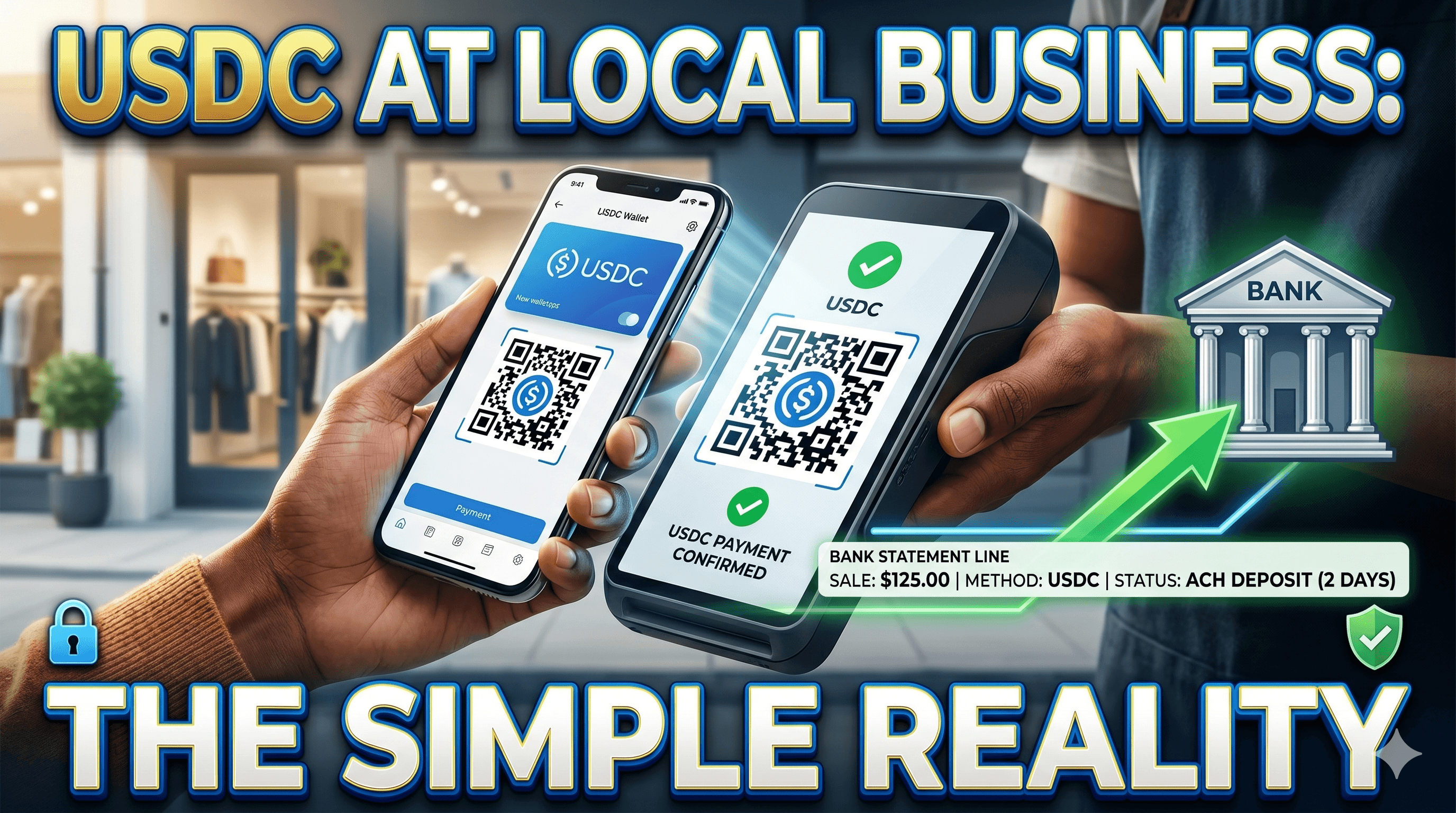
Here's the short answer: the customer holds up their phone, scans a QR code, confirms the payment, and puts their phone in their pocket. The merchant's terminal displays a confirmation. Dollars land in the merchant's bank account within two business days. Their bookkeeper records a dollar sale.
That's the whole transaction.
Most of the confusion around crypto payments at local businesses comes from imagining a more complicated process than actually exists. A USDC payment at a retail counter doesn't require the merchant to understand cryptocurrency, hold a digital wallet, or do anything different from what they already do when a customer pays with a card. The mechanism underneath is different. The experience is nearly identical.
Here's what actually happens, step by step.
What the Customer Does
The customer tells the merchant they'd like to pay with USDC. The terminal generates a payment request — a QR code that appears on the merchant's screen or a secondary display facing the customer.
The customer opens their crypto wallet app — Coinbase Wallet, MetaMask, Trust Wallet, or any of dozens of others — and points their phone's camera at the QR code. The wallet reads the payment request and displays the amount: a specific number of USDC, which equals exactly the same number in U.S. dollars. One USDC is one dollar. Always.
The customer reviews the amount and taps confirm. The payment broadcasts to the blockchain. Within seconds to a few minutes, the transaction receives confirmation. The customer's wallet shows a success screen. They put their phone away and leave with their purchase.
From the customer's perspective, this takes roughly the same time as a contactless card tap. Possibly a few seconds longer on a slow network day. Generally faster than inserting a chip card and waiting for authorization.
What the Merchant Sees
The terminal confirms the payment. A green check. A dollar amount. Done.
The merchant doesn't touch anything related to cryptocurrency. They don't hold USDC. They don't manage a wallet. They don't log into any exchange. The terminal displays confirmation the same way a card reader displays approval — a single screen with an amount and a status.
Behind that screen, the payment processor has already handled everything. The USDC arrived in the processor's infrastructure. Because USDC is pegged 1:1 to the U.S. dollar, no conversion is needed — one USDC equals one dollar by design, so the merchant's dollar amount is exactly what was requested. The processor aggregates the day's transactions and initiates an ACH transfer to the merchant's bank account. The funds typically arrive within two business days, the same timeline as a standard card settlement.
The merchant's experience, from the moment the customer scans to the moment the receipt prints, looks like any other digital payment.
What the Bookkeeper Sees
This is the question that stops most merchant conversations cold.
The bookkeeper sees a dollar sale.
Not a crypto transaction. Not a digital asset. A line item that reads: sale, dollar amount, date. Identical in structure to any other payment type the business accepts.
The processor deposits funds in U.S. dollars. The merchant's bank account shows a dollar credit. There is no cryptocurrency on the merchant's books at any point. No exchange rate to calculate. No asset to value. Nothing that requires a separate category in the accounting system.
Coinbase Commerce describes its settlement this way: automatic conversion to the merchant's chosen fiat currency at the time of payment. The bookkeeper who reconciles that account sees an ACH transfer from a payment processor — the same thing they see from any other processor — denominated in dollars.
If the merchant uses QuickBooks, Square Dashboard, or any standard accounting software, the crypto payment entry looks exactly like an entry from any other payment method. Category: sales revenue. Amount: dollars. Done.
What If the Price Moves While the Transaction Is Processing?
With USDC, it doesn't. That's the point of a stablecoin.
USDC is issued by Circle — publicly traded, licensed as a money transmitter in 48 U.S. states, and regulated under the GENIUS Act signed in July 2025. Every USDC in circulation is backed 1:1 by cash held at regulated financial institutions and short-dated U.S. Treasury securities. Those reserves are managed by BlackRock and audited every single month by Deloitte. The result is a digital dollar that holds its peg with daily fluctuation measured in fractions of a cent — between $0.9990 and $1.0016 in practice.
When a customer pays with USDC, there is no Bitcoin price to worry about. No exchange rate window to manage. One USDC equals one dollar at the moment the customer initiates the payment, at the moment the blockchain confirms it, and at the moment the processor deposits the funds. The merchant requested $47.50. They receive $47.50.
For merchants who accept Bitcoin or Ethereum instead of USDC, the rate-lock mechanic handles what USDC solves structurally. Payment processors lock the exchange rate the instant the invoice is generated. BitPay's documentation states it plainly: the customer pays the invoice at a locked-in exchange rate. Whatever happens to Bitcoin's price after that moment is irrelevant to the merchant's settlement amount. The processor absorbed the conversion at the locked rate and deposits the exact dollar amount the merchant requested.
Either way — stablecoin or converted crypto — the merchant's dollar outcome is fixed before the customer confirms the payment.
What Does the Merchant Tell Their Accountant?
The same thing they'd say about any other sale.
"We had a customer pay $230 on Tuesday. Came through the processor. Should be in the account by Thursday."
No additional explanation required. The transaction doesn't carry any unusual characteristics from the bookkeeper's perspective. There's no crypto on the balance sheet. No digital asset to fair-value. No unfamiliar line item.
The IRS property classification for cryptocurrency — the rule that creates capital gains events when individuals spend crypto — applies to the spender, not the receiver. The merchant receiving dollars from a payment processor has a standard dollar sale. Their tax treatment is unchanged. Their accounting workflow is unchanged.
Some merchants ask whether they need separate disclosure for accepting crypto payments. In most jurisdictions, the answer is no — because from the merchant's perspective, they didn't accept crypto. They accepted a payment and received dollars. The processor handled the crypto layer. The bookkeeper never had to touch it.
What If the Customer's Wallet App Doesn't Work?
It happens. Apps freeze. Wallets lose connectivity. Customers sometimes open the wrong wallet first.
The process handles this exactly the way a card transaction handles a declined card: the customer tries a different method.
Most crypto wallet apps generate a payment from a QR code in under ten seconds when working normally. When they're not, the customer can pay with cash, a card, or a different wallet. The merchant doesn't troubleshoot the customer's app. The payment attempt simply doesn't complete, the terminal resets, and the customer pays another way.
For merchants concerned about transaction failure rates, the documented approval rate from processors like ForumPay runs at 99.99%. Most incomplete attempts are customer-side — the customer doesn't have sufficient funds or cancels — not infrastructure failures.
The backup process isn't different in kind from what happens when a card is declined. Another payment method is used. The business keeps moving.
The Reaction Most Merchants Have When They See This for the First Time
It's almost always the same.
"That's it?"
The expectation going in is complexity — a system that requires the merchant to learn something new, manage something technical, or explain something unfamiliar to their staff. The reality is a QR code, a customer's phone, and a confirmation screen. The infrastructure that makes it work is invisible to everyone at the counter.
The bookkeeper who looked skeptical at the mention of crypto will see a dollar deposit from a payment processor. The staff member who processes the next transaction won't do anything different from what they did the day before. The merchant won't manage a wallet or call an exchange or think about stablecoins again until the next time a customer asks to pay with one.
The transaction is simple because the infrastructure absorbed the complexity. That's what payment processors are built to do.
For businesses that already field customer requests to pay in crypto — a NCA/PayPal survey of 619 payment decision-makers found 88% of merchants already receive those requests, with 69% coming in at least monthly — the question after seeing this walkthrough usually changes. It shifts from "how does this actually work" to "why haven't we done this yet."
The mechanics are straightforward. The bookkeeper will know exactly what to do with it. And the customer who's been asking every month will finally get to say yes.
The Dividend Shift Team supports partners building residual income through crypto payment terminal placement. Dividend Shift was founded by Gedam Tekle, a former U.S. Marine and Oakland Police Sergeant who has personally exited two eight-figure companies and helped over 4,000 entrepreneurs build infrastructure-based businesses.