
Published on:
What Is Fiat Settlement And Why Merchants Don't Fear Crypto Prices?

What Is Fiat Settlement And Why Merchants Don't Fear Crypto Prices?
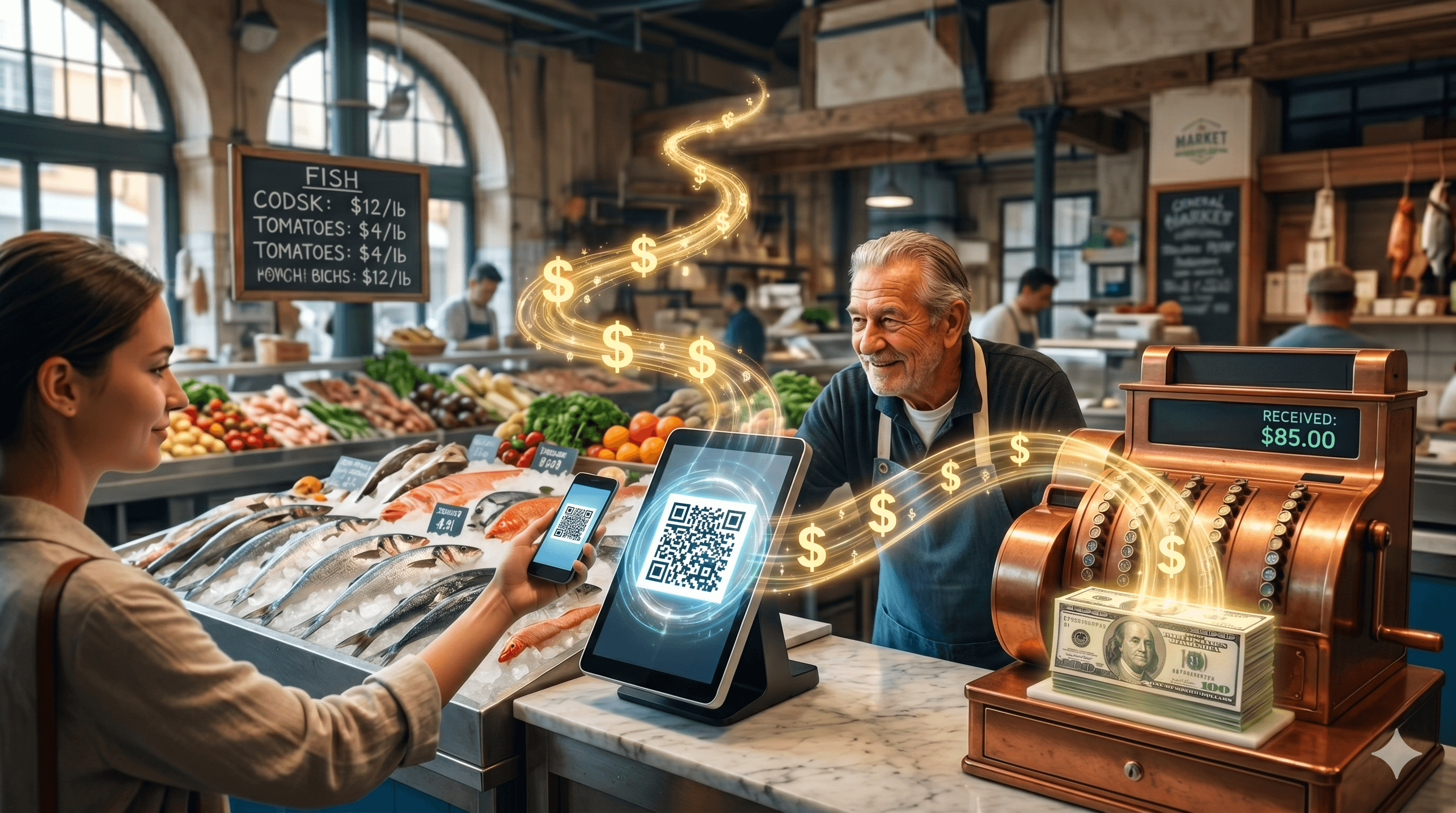
Merchants don't have to hold crypto. They never touch it. They receive dollars — the same way they always have.
That one sentence eliminates the doubt we hear from business owners when we explain what Dividend Shift does. Not "I don't understand crypto." Not "I don't trust it." The real question, underneath everything else, is this: What happens to my money when Bitcoin drops 40% in a weekend?
The answer is: nothing.
And the mechanism that makes that true is called fiat settlement.
What Fiat Settlement Means
Fiat settlement is the process by which a crypto payment processor converts cryptocurrency to U.S. dollars at the moment of the transaction and deposits those dollars into the merchant's bank account.
The merchant never holds crypto. Not for a second.
Here's the exact sequence:
A customer scans the QR code at the point-of-sale terminal. At that precise moment — not end of day, not when the bank opens Monday morning — the processor locks the exchange rate. The customer sends Bitcoin, Ethereum, USDC, or another supported currency from their wallet. The processor receives the crypto, converts it to USD at the locked rate, and routes the dollars to the merchant's account.
BitPay — one of the largest crypto payment processors operating today — documents this explicitly: merchants generate invoices in their settlement currency, and the customer pays at a locked-in exchange rate. That rate is set the instant the invoice is created. It doesn't move.
The merchant receives the exact dollar amount that was on the receipt.
Whatever Bitcoin does in the next hour is irrelevant. The merchant's dollars are already in transit.
The Window of Crypto Exposure Is Measured in Seconds
I want to be precise about this, because it's the part people struggle to believe until they see the mechanics.
From the moment a customer initiates a payment to the moment the processor converts crypto to USD, we're talking about seconds. Not minutes. Not hours. Seconds.
That is the entire window during which any price movement could theoretically affect the transaction.
And then it's gone. The exchange rate is locked. The conversion is done. The merchant has dollars.
BitPay's settlement documentation makes this clear from the processor's side: they send the received funds to exchanges to obtain fiat currency, then pay merchants. The conversion isn't theoretical — it happens as part of the transaction flow itself.
Fiat deposits hit the merchant's bank account via ACH. Standard timeline: two business days. BitPay also offers daily crypto settlements processed within approximately one hour for merchants who want faster access. Either way, the merchant isn't waiting on crypto prices. They're waiting on the same ACH pipeline they use for every other electronic payment.
Why the Volatility Fear Is a 2012 Problem
The assumption that accepting crypto means holding crypto was accurate when early merchants accepted Bitcoin directly into personal wallets and managed their own conversion. That was 2012 and 2013. That's when the volatility risk was real.
Modern crypto payment processors exist specifically to eliminate that risk. The entire point of the infrastructure layer — the processors, the terminals, the settlement architecture — is to make the merchant's experience identical to accepting any other form of payment.
The Deloitte/PayPal survey found that 36% of merchants cited market volatility as a barrier to accepting crypto. The NCA/PayPal survey from January 2026 found that 90% said they would accept crypto if they could convert instantly to fiat.
That instant conversion already exists. Has existed for years. The barrier isn't the technology. The barrier is awareness.
Most merchants are afraid of a problem that was solved before they ever heard about it.
Stablecoins: When There's Nothing to Convert
Fiat settlement handles the volatility problem for Bitcoin and Ethereum payments. But for stablecoins, the problem doesn't exist in the first place.
USDC — issued by Circle, managed by BlackRock, custodied at Bank of New York Mellon, audited monthly by Deloitte — is a digital dollar. Its market cap sits at $78 billion. Its reserves are 100% backed by cash at regulated financial institutions and short-dated U.S. Treasury bills. Circle received conditional OCC approval in December 2025 to establish the First National Digital Currency Bank.
When a customer pays with USDC, one USDC equals one dollar. By design. Always.
The daily price range for USDC is $0.9990 to $1.0016. There is no conversion step. The merchant receives a digital dollar that settles in minutes. Bitcoin's price that day has zero relevance to the transaction.
Stablecoin transfer volume hit $27.6 trillion in 2024 — surpassing the combined transaction volume of Visa and Mastercard. Retail stablecoin transactions rose over 125% between the first three quarters of 2024 and the same period in 2025. This isn't fringe activity. This is a mainstream payment rail that most merchants have never been introduced to.
Why This Makes the Merchant Conversation Much Easier
When I train partners to approach local business owners, the volatility objection comes up almost every time. Within the first three minutes.
The mistake is trying to explain crypto to overcome it. You don't need to.
The honest answer is: "The merchant receives dollars. The processor handles conversion. The entire price exposure window is seconds. Here's how BitPay documents it."
That's it. The fear evaporates when the mechanism is explained clearly.
The business owner who runs a barbershop doesn't need to understand blockchain. He needs to know that a customer can tap a phone, he gets $85 in his account in two days, and nobody can reverse the charge later. That's the conversation fiat settlement makes possible.
What This Means for a Dividend Shift Partner
Partners placing crypto payment terminals at local businesses earn a residual on transaction volume. That residual is calculated in dollars — not in Bitcoin, not in any cryptocurrency.
The terminal processes a $400 sale. The partner earns their percentage of $400. The fact that the customer paid in Ethereum is a back-end detail. The partner's income is denominated in the same currency as the merchant's revenue.
This matters for conversations with skeptical business owners, but it also matters for partners evaluating the business model itself. The income isn't correlated to crypto price movements. It's correlated to transaction volume. The more merchants process, the more the partner earns — regardless of what the market does.
That's the infrastructure model. The processor carries the conversion risk. The merchant receives dollars. The partner earns residuals. Everyone downstream is insulated from price volatility by the settlement architecture.
The Doubt Worth Addressing Directly
You might be thinking: if fiat settlement solves the volatility problem, why aren't more merchants accepting crypto already?
Fair question. The NCA/PayPal survey covered 619 payment decision-makers. Eighty-eight percent said their customers had already asked about paying with crypto. Ninety percent said they'd accept it if conversion were instant and simple.
The gap isn't technical. It's distribution. Nobody has walked these merchants through the mechanics. Nobody has set up the terminal, explained the settlement flow, and answered the question: will I end up holding Bitcoin?
The answer is no. Fiat settlement is the reason. And that answer — clearly explained — is what turns a skeptical business owner into a signed location.