
Published on:
Can You Build a Crypto Payment Terminal Business While Working Full-Time?
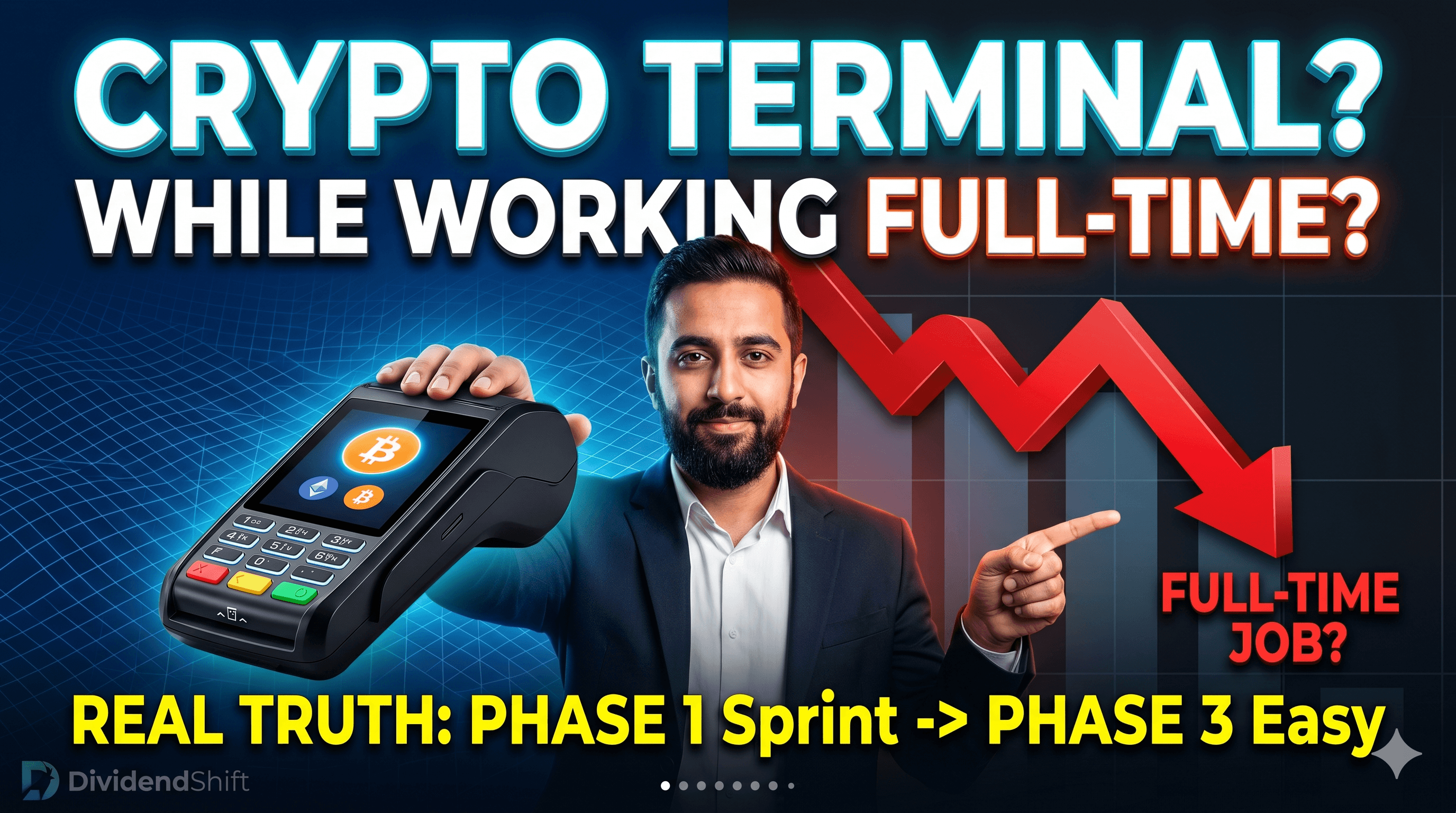
Yes. But the honest answer is more useful than the short one.
Most people asking this question aren't really asking about time management. They're asking something more specific: will this require me to quit my job before I know if it works? Do I have to choose between my salary and this income stream? Is "1 to 3 hours per week" actually true, or is that the thing every business pitch says before the reality sets in?
Those are the right questions. And they deserve a real answer, not a reassurance.
Here's what I can tell you from building this myself while still carrying a badge: the time requirement for this business is real, it's front-loaded, and it compresses dramatically once the portfolio is built. Understanding which phase you're in — and what that phase actually demands — is the difference between building this successfully alongside a full-time job and burning out because you didn't map the calendar before you started.
Let me walk through all three phases. Real hours. Real weeks. No softening.
Why Most "Passive Income" Businesses Get the Work Wrong
Before the phases, I want to say something that almost nobody in this space says clearly enough.
There is no such thing as a business with zero upfront work. Anyone who tells you otherwise is selling you something. The question isn't whether a business requires work. The question is what kind of work, when, and whether the work eventually stops scaling with the income.
Most businesses that get sold as "passive income" fail on the second and third criteria. ATM operators do ongoing physical labor — driving routes, loading cash, servicing machines — and that labor scales linearly with the number of machines. Every machine you add means more routes, more cash handling, more time. The income grows. So does the job.
Rental property is the same problem.
One unit is manageable.
Ten units means ten times the tenant calls, maintenance issues, and lease renewals.
You can hire a property manager, but then you're managing the property manager. The work changes form. It doesn't go away.
The crypto payment terminal model has a different structure.
The work is genuinely front-loaded — meaning the heavy-labor phase is a defined window, not a permanent condition. Once a merchant is placed, the terminal processes transactions automatically. The residual flows without any ongoing work from you.
The merchant doesn't need you to show up every week, reload anything, or manage anything on their end. You earned that residual by doing the work once, and it continues as long as the merchant processes payments.
That structural difference is real.
But it doesn't mean the front end is light. So let me be specific about what that front end actually looks like.
Phase 1 — The Placement Window: Weeks 1 Through 12
I'm going to walk you through what a real week looked like for me when I was in active placement mode. Not the optimistic version — the actual version.
My target during the heavy phase was three to five conversations with business owners per week. That number is achievable alongside a full-time schedule, but it requires intention. A conversation with a business owner isn't a phone call. It's identifying a target merchant, doing basic research on their business, showing up in person or making a warm introduction, handling the initial objection set, and following up within 48 hours.
The time breakdown for a typical active placement week:
Monday and Tuesday evenings: target identification and outreach preparation.
This means reviewing the merchant targeting criteria — ticket size over $100, owner-operated, customer base 25 to 50, processing fees above 2.5% — and building a list of businesses worth approaching that week. Roughly two hours per evening, or four hours total.
Wednesday through Friday: conversations and follow-ups. Three in-person merchant visits at 30 to 45 minutes each, plus follow-up emails or calls after each one. Roughly five to six hours.
Saturday morning: one to two hours reviewing the pipeline, tracking which conversations are progressing, scheduling installations for merchants who said yes.
Installation days: when a merchant agrees, the terminal needs to be set up and the owner or their staff needs a brief walkthrough. This runs 60 to 90 minutes per location. In an active month, you might have two to four installations.
Total time in Phase 1: 15 to 20 hours per week. Some weeks run higher if you're doing multiple installations. Some weeks are lighter if you're in follow-up mode rather than active outreach.
That is not nothing. I want to be clear about that.
Fifteen to twenty hours on top of a full-time job is a second job. You're not going to coast through this phase while watching TV. You're spending evenings and weekends doing real sales work — having business conversations, answering objections, building relationships.
But here's what makes it manageable. This phase has a defined end.
You are not doing this work forever. You are doing this work until your portfolio is built. And the Dividend Shift framework is designed to get you operational within three weeks and to your first placements within the first 30 days. The placement phase is a sprint, not a marathon.
National Payment Processing's income progression model illustrates the trajectory: three merchant accounts in month two generates approximately $281 per month in residuals.
Fifteen merchants by month six generates approximately $4,215 per month. The placement work you do in months one through six is building a portfolio that pays you for years without any corresponding increase in ongoing effort.
Phase 2 — Early Portfolio: Months 3 Through 12
At some point — typically around months three to four — the ratio shifts. You have five to eight placements generating income. The active placement grind is still happening, but you're adding to an existing base rather than building from zero.
This phase feels meaningfully different. Here's what a real week looks like in Phase 2.
A few hours on weeknights for new merchant conversations — but you're working from referrals now, not cold outreach.
The business owners you've already placed are your social proof. They tell their network. The conversations get shorter because the credibility is established before you walk in. Most of my best placements in year one came from referrals from the first three merchants I placed.
One check-in call or visit per month to each active merchant. Not because the terminal needs servicing — it doesn't — but because maintaining the relationship is how you protect the residual. The call takes ten minutes. You ask how transactions are going. You remind them you're available if anything comes up. That's the maintenance requirement for an active merchant account.
The income is arriving monthly and starting to compound.
Each new placement adds to the base. Each existing merchant who processes more volume increases the residuals without any additional work from you.
The compounding effect becomes visible.
Total time in Phase 2: 8 to 12 hours per week. Still a real commitment. Still requires consistent effort. But you're past the all-out sprint of Phase 1, and the income you built in Phase 1 is running in the background.
Phase 3 — Mature Portfolio: Month 18 and Beyond
This is what "1 to 3 hours per week" actually refers to.
By month 18 to 24, an operator who has been consistent through Phase 1 and Phase 2 has somewhere between 15 and 30 active merchant accounts. Those accounts are processing transactions. The residuals are flowing. The placement work is substantially complete.
What does a real week look like in Phase 3?
Dashboard review: once a week, five to ten minutes looking at transaction volume across your portfolio. You're looking for anything unusual — a merchant whose volume dropped significantly, which might indicate they've stopped using the terminal or have a problem worth addressing.
The occasional merchant check-in: once a month per merchant, cycling through your portfolio. You might touch two to three merchants per week in rotation. Ten minutes per call. The relationship stays warm. The residual stays protected.
New placement activity: in a mature portfolio, you're not doing aggressive outreach every week. You might have one new merchant conversation per week — either a referral that came in or a business you noticed that fits the profile. This is optional, not required. Your existing income doesn't depend on new placements. But every new placement increases the base.
Total time in Phase 3: 2 to 4 hours per week, depending on how active you choose to be with new placements.
That's the number. That's what 1 to 3 hours per week refers to — maintaining an existing portfolio that's already operational, not building one from scratch.
Beacon Payments, which has been in the merchant services residual business for decades, describes their most established agents plainly: some of their reps haven't written a deal in five years and still receive their monthly residual check. The portfolio keeps earning because the merchants keep processing. No new work required.
What Switching Costs Do For Your Time Investment
There's a structural feature of this model that directly affects the time math — and almost nobody talks about it.
Once a merchant has a terminal installed, integrated into their checkout process, and familiar to their staff, they don't switch processors. The friction of changing payment infrastructure is real: new hardware, new staff training, new integrations, potential downtime. Merchants in traditional credit card processing stay with their processors for years, often a decade or more.
The same dynamic applies to crypto payment terminals. The work you do in Phase 1 — placing the terminal, walking the owner through the setup, handling their initial questions — creates a switching cost that protects your residual income going forward. That merchant isn't looking for a replacement. Your work is done. The income continues.
This is the structural reason the time front-loading works in your favor. Every hour you spend in Phase 1 earns you a residual that runs with no additional hours attached to it. You're not buying temporary income. You're buying permanent income that required work once.
The industry data on churn is worth knowing honestly: merchant services portfolios see approximately 15% to 20% annual churn. That's real, and it means some merchants will close their businesses, switch processors, or stop accepting crypto over any given year. A portfolio of 20 merchants loses two to four per year to attrition on average. That's why maintaining some ongoing placement activity — even light activity in Phase 3 — is advisable. You're offsetting attrition and adding to the base.
But it's managed attrition. Not a daily operational crisis.
The Comparison: What a Landlord's Time Actually Looks Like
I want to put this in perspective against the alternative most people consider when they think about residual income.
A single rental property at a 15% annual churn rate means you're re-renting once every six to seven years on average. That sounds manageable. But the work isn't evenly distributed. A tenant transition is not two to four hours. It's a vacancy period, a showing process, a screening process, a lease execution, a move-in walkthrough, and — in the worst case — a situation where the outgoing tenant leaves the property in a condition that requires repairs before the next tenant moves in.
And that's the planned work. The unplanned work — the 11 p.m. call about a burst pipe, the HVAC system that fails in August, the parking dispute that becomes a legal issue — doesn't schedule itself around your availability. It arrives when it arrives. Your law enforcement shift doesn't pause for it.
J.D. Power research consistently shows rental property owners underestimate ongoing time requirements by 40% to 60% in the first two years of ownership. The passive income fantasy and the active management reality are significantly different.
The crypto payment terminal portfolio in Phase 3 has no equivalent disruption. There is no plumbing. There is no tenant. There is no physical asset degrading on a schedule you didn't choose. The terminal processes transactions. The residual deposits. You check the dashboard on Thursday morning for ten minutes and go on with your day.
What I Was Doing When I Built This Alongside Law Enforcement
I want to be straight with you about how this actually went for me, because the story matters more than the framework.
When I was in Phase 1, I was working patrol shifts and doing merchant conversations on my off days and evenings. I was tired. There were nights I didn't want to make the call or do the follow-up. The business wasn't paying me anything yet, and I was spending real time on it while carrying a career that already demanded a lot.
What kept me going was understanding the structure. I wasn't building something that would require this level of effort permanently. I was building a portfolio. Each placement was a permanent addition to a compounding base. The work I did on a Friday evening in month two was still generating residuals 18 months later without any additional Friday evenings attached to it.
By month six, the math had shifted.
By month 18, the portfolio was running on its own. I was checking it the way you check a 401(k) — periodically, not anxiously.
I did not quit law enforcement before the income was real. I did not bet my family's financial situation on a hypothesis. I built the income stream alongside the career, verified it was working, and then made a decision with actual information rather than a pitch deck.
That's the path. It requires real time upfront. It compresses to something genuinely manageable once the work is done.
Gedam Tekle is a former U.S. Marine and Oakland Police Sergeant who left law enforcement to build crypto payment infrastructure businesses. He has personally exited two eight-figure companies and helped over 4,000 entrepreneurs build residual income. He is the founder of Dividend Shift.