
Published on:
Bitcoin ATMs Are Declining. Crypto Payment Terminals Are Growing. Here's Why.

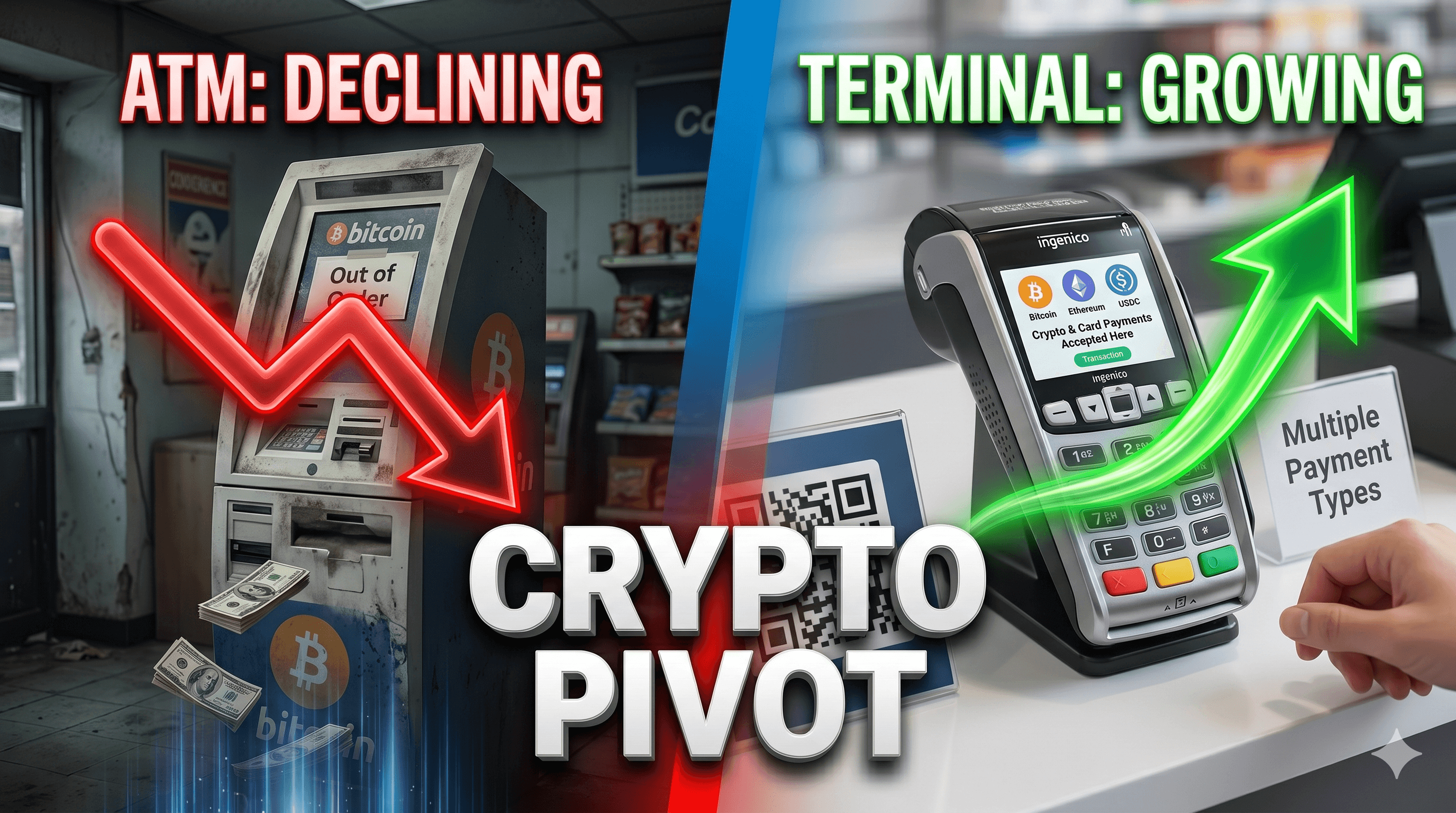
If you've been researching the Bitcoin ATM business, you've probably noticed something uncomfortable in the data: the industry is under pressure. Machines are being removed from stores. Regulatory costs are climbing. The consumer fees that made the model look attractive on paper — typically 8 to 20 percent per transaction — are generating regulatory scrutiny and consumer backlash in equal measure.
The honest answer to "Is the Bitcoin ATM business dying?" is: not dead, but structurally challenged in ways that are accelerating, not resolving. The headwinds are real and they're getting harder to ignore.
There's a different business model in the same crypto space — one most people researching ATMs have never heard of — that runs in the exact opposite direction. It's called a crypto payment terminal. It charges 0.5 to 1 percent. It requires no cash float, no money transmitter license, and no driving routes. And it's positioned with the growth of digital payment adoption instead of against the decline of cash.
This post explains the structural difference between the two — clearly, side by side — so the comparison can speak for itself.
What a Bitcoin ATM Is and How It Actually Makes Money
A Bitcoin ATM is a kiosk. A customer walks up to it, feeds in cash, and receives cryptocurrency — or, in two-way machines, sells crypto for cash. The machine operator earns by charging a spread between the buy and sell price of Bitcoin. That spread typically runs 8 to 20 percent, depending on the operator and location. Most customers aren't shown the percentage — they're shown an exchange rate and the resulting crypto amount. But the math is transparent: a customer putting $500 in cash into a machine at a 15 percent fee walks away with roughly $425 worth of Bitcoin at market price.
The spread is the revenue. A high-traffic machine can generate $300 to $800 per month in gross profit once the host location takes its revenue share and the operator covers maintenance and cash handling costs.
Three operational requirements come with every machine and never go away.
Cash loading is the first. The machine needs physical currency stocked on a regular basis. That means driving routes, handling bills, and scheduling time around the machine's depletion rate. There is no way to automate this.
FinCEN registration is the second. Crypto ATM operators are classified as money services businesses under federal law. That triggers Bank Secrecy Act compliance, AML protocols, and ongoing regulatory reporting. None of this is optional.
State licensing is the third — and it's the one that surprises most people evaluating this business. Operating a crypto ATM as a money transmitter requires a license in nearly every state where machines are placed. The surety bonds alone run $100,000 to $1,000,000 per state, depending on transaction volume. Some operators have pulled machines from entire regions because the licensing math doesn't work at their scale.
Why the ATM Business Is Under Pressure Right Now
Three converging forces are making the Bitcoin ATM model harder to operate profitably, and they're all structural rather than cyclical.
Cash usage is falling. In developed markets, cash transactions have dropped to roughly 20 percent of total payment volume and continue declining. Bitcoin ATMs depend on people who prefer physical dollars and want to convert them to crypto. That population is real. It's not growing. The secular trend runs directly against the business's customer base.
Regulatory scrutiny is increasing. The FTC, CFPB, and multiple state attorneys general have escalated enforcement actions against Bitcoin ATM operators in the past two years. The industry has become a primary vector for financial fraud targeting older adults — scammers instruct victims to convert money at Bitcoin ATMs, and regulators have taken notice. The compliance burden was already high before the enforcement wave. It's materially higher now, with some states implementing per-transaction limits specifically for Bitcoin ATMs and others considering outright caps on fees.
Consumer fee resistance is building. The 8 to 20 percent spread is the operator's revenue mechanism and the customer's biggest complaint. It's the most common negative theme in reviews of every Bitcoin ATM in the country. As awareness grows and competitors enter the market, pressure on those spreads increases — which compresses the operator's income directly.
Codie Sanchez, who has publicly built a portfolio of "boring businesses" generating eight figures in annual revenue, has named ATMs specifically among businesses she would never invest in. Her critique: a declining underlying asset, thin margins at scale, and operational requirements that prevent the model from becoming genuinely passive. She was describing cash ATMs. Each of those critiques applies to Bitcoin ATMs with additional regulatory weight.
What a Crypto Payment Terminal Is
A crypto payment terminal is a point-of-sale device placed at a merchant's location — a barbershop, an auto shop, a specialty retailer, a dental office. When a customer wants to pay with Bitcoin, Ethereum, USDC, or another supported cryptocurrency, they scan a QR code on the terminal. The payment processor converts the crypto to U.S. dollars at a locked exchange rate. The merchant receives dollars in their bank account within two business days.
The terminal operator — the person who placed the device — earns a residual percentage of every transaction the merchant processes. That residual is drawn from the processing fee charged to the merchant, which runs 0.5 to 1 percent of transaction value. It deposits every month, from every merchant in the portfolio, for as long as those merchants continue processing payments.
There is no cash float. No loading schedule. No driving routes. No money transmitter license when operating as an agent under a licensed processor's regulatory umbrella — the processor holds the compliance infrastructure, and the agent operates within it on a standard business license.
The work is merchant placement: identifying businesses whose customers are already asking to pay with crypto and getting the terminal set up. Once placed, the terminal runs. The residuals follow.
The Structural Comparison
These two businesses operate from opposite premises, and the differences compound across every dimension that matters.
Fee structure. Bitcoin ATMs charge the customer 8 to 20 percent per transaction. Crypto payment terminals charge the merchant 0.5 to 1 percent. One fee is 15 to 40 times higher than the other. This gap reflects fundamentally different economics and entirely different value propositions to the end user.
Regulatory burden. Bitcoin ATMs require money transmitter licensing in nearly every state, FinCEN MSB registration, and surety bonds reaching into seven figures for high-volume operators. Crypto payment terminals, operated as an agent under a licensed processor, require a standard business license. The processor absorbs the compliance infrastructure.
Capital requirements. A Bitcoin ATM machine costs $2,000 to $14,000, plus $3,000 to $5,000 in cash float that has to be physically maintained. A crypto payment terminal costs $200 to $1,500 and requires no ongoing inventory of any kind.
Trend direction. Bitcoin ATMs serve people who want to convert cash into crypto — behavior tied to cash usage, which is declining at roughly 4 to 5 percent annually in developed markets. Crypto payment terminals serve merchants who want to accept crypto from customers who already hold it — behavior tied to digital payment adoption and crypto ownership, both of which are growing. Stablecoin transfers totaled $27.6 trillion in 2024, surpassing the combined transaction volume of Visa and Mastercard. Retail stablecoin transactions grew over 125 percent between the first three quarters of 2024 and the same period of 2025. The GENIUS Act, signed into law in July 2025 with bipartisan support — 68 to 30 in the Senate, 308 to 122 in the House — established the first federal regulatory framework for digital payment stablecoins. These are not indicators of a trend retreating. They're indicators of infrastructure being laid for mainstream adoption.
Operational model. Running Bitcoin ATMs requires ongoing physical labor: loading cash, maintaining machines, managing location relationships, and handling customer service for a product that generates the most complaints in the industry. Running a crypto payment terminal portfolio requires placing the terminal once and maintaining a merchant relationship that looks like a monthly check-in call.
Income structure. ATM income is spread-based — you earn on each transaction processed at your machine, but each transaction is a discrete event. Crypto payment terminal income is residual — every merchant placement adds permanently to a compounding base that continues earning without additional work. Industry data on mature merchant services portfolios shows agents earning for years from accounts they placed and haven't actively managed since.
What This Means for Someone Evaluating Either Business
The person researching Bitcoin ATMs is typically looking for the same thing as anyone evaluating any infrastructure business: a systematic income stream that doesn't require constant labor, doesn't demand a second full-time job, and compounds over time.
The ATM model looked like that on paper. The operating realities — physical cash routes, multi-state licensing compliance, fee compression, and a declining consumer base — make it considerably more labor-intensive and more regulatory-exposed in practice than the pitch suggests. The headwinds described above aren't short-term disruptions. They're structural features of what the business is.
The crypto payment terminal model is built closer to what most people who evaluate ATMs are actually looking for. One-time placement work per merchant. Ongoing residuals from transaction volume. No physical inventory. No cash handling. No money transmitter licensing burden. And the model is positioned on the right side of where payment adoption is going — digital, stablecoin-backed, merchant-facing — rather than on a model dependent on a declining behavior.
The two businesses share a three-letter overlap: they both involve crypto. The structural reality underneath couldn't be more different.
For anyone who arrived at this post while researching Bitcoin ATMs, the Dividend Shift overview covers what the terminal placement model looks like in practice — the mechanics, the income structure, and what the first 90 days actually require. It's worth reviewing before committing capital or time to either model. The comparison will be obvious once both are on the table.
The Dividend Shift Team supports partners building residual income through crypto payment terminal placement. Dividend Shift was founded by Gedam Tekle, a former U.S. Marine and Oakland Police Sergeant who has personally exited two eight-figure companies and helped over 4,000 entrepreneurs build infrastructure-based businesses.