Published on:
How to Explain This Business to Your Wife in 10 Minutes

The conversation you're nervous about isn't really about crypto.
It's about every time before this when you got excited about something and it didn't work. The Robinhood account. The crypto portfolio that dropped 40%. The course you bought and never finished. The MLM you swore was different.
She remembers all of it. She's been patient. And she is not going to let you spend real money on another thing — not without a real conversation.
That's not a problem. That's actually the right call. The fact that she holds you accountable is exactly why you should have this conversation instead of avoiding it.
Here's what I've learned coaching over 4,000 people through this business: the spouse conversation is almost never about the business itself. It's about trust. And trust is rebuilt with specifics, not enthusiasm.
So let me give you the specifics.
What Not to Say First
Do not open with "crypto."
I'm serious. The moment that word comes out of your mouth, she's already calculating how much you lost last time and bracing for the next version of the same story. You haven't said anything wrong yet, but you've already lost two minutes digging out of a hole.
Don't say "passive income" either. She's heard that before.
And don't say "opportunity." That word is the verbal equivalent of a flashing warning light for any spouse who's been through this once already.
The problem isn't the words. The problem is that those words carry years of baggage. You need to start somewhere she hasn't already written the ending to.
Start Here Instead
Say this: "I want to show you a business that's been running for 40 years — and I found a way to build a version of it in the crypto space before the big companies get there."
That's it. That's your opening.
Why does that work? Because it doesn't ask her to trust crypto. It asks her to look at a 40-year-old business model. And it acknowledges that there's a timing element without sounding like a pitch.
Now let her ask the next question. Don't keep talking. She will ask something. And what she asks will tell you exactly what she's actually worried about.
The Three-Sentence Explanation
When she asks how it works, here's what you say:
"You know how every business has a credit card terminal? Someone placed that terminal — and earns a small percentage of every transaction that business processes, every month, forever. We're going to do the same thing, but for crypto payments."
That's it. Three sentences.
Don't add to it. Don't elaborate. Let her sit with it.
If she says "I don't understand," you've explained it too fast. Slow down and walk through it: businesses accept payments, payments generate fees, the person who placed the terminal earns a slice of those fees. Same thing, same model, different payment method.
This model — ISO agent residual income — has governed how credit card terminals work since Visa introduced the first POS terminal in 1979. It's the oldest, most boring business structure in the payments industry. Visa built a trillion-dollar market cap off of it. The agents who placed credit card terminals in local businesses in the 1980s collected residuals for decades without touching the machines again.
That's what we're building. Just earlier in the cycle for crypto.
What She's Actually Worried About
She's going to say something like "so we're buying crypto?" or "what if the price crashes?"
These are the questions that matter most — and they're the easiest to answer correctly.
"We don't buy any crypto. We don't own any crypto. We place a payment device at a business. When one of their customers pays with crypto, the processor converts it to dollars instantly — the business gets dollars, we get a percentage of the transaction fee. Bitcoin can go to zero and we still collect our percentage of every transaction that processed."
That last sentence is the one she needs to hear twice.
This business is not crypto investing. There is no price exposure. There's no "what if it crashes." The way the payment processors are built, the merchant always receives dollars. The fee we earn comes from the transaction, not from the value of any coin. We are the infrastructure. We are not the bet.
The analogy that usually lands: "It's like owning a Visa machine, not owning Visa stock."
The Numbers She's Going to Ask For
She will ask — directly or indirectly — what this costs, what it makes, and how much of your time it takes.
Here's what's true:
The entry into this program is around $9,800. That covers the devices, the training, the systems, and a done-with-you framework to get the first locations placed. You're not buying inventory. You're not hiring anyone. You're not opening a storefront. That money buys you a positioned business with mentorship built in.
Each placed device earns an estimated $200 to $1,000 per month in residuals, depending on the merchant's transaction volume. Start with 5 locations and you're looking at $1,000 to $5,000 a month — before any growth. Scale to 15 and the math gets serious.
Time requirement once the portfolio is built: 1 to 3 hours per week. You're checking a dashboard. You're doing a quick merchant check-in once a month. You are not driving routes, loading cash, managing employees, or taking 11 p.m. calls about broken equipment.
During the first few months — the placement phase — it's more. Real sales work. Real business conversations. Evenings and some weekends. I'm not going to tell her it's effortless, because it's not. But the work is front-loaded. What you build in months one through six pays you for years without any corresponding increase in weekly effort.
The Objection She Won't Say Out Loud
Here's the one that's hardest to address, because she probably won't say it directly.
It's not about the money or the time. It's about trust. Specifically: "You always get excited about something new and it goes sideways. Why is this different?"
You don't defend yourself here. You agree with the pattern.
"You're right. I've pitched things before that didn't pan out. This is different in one specific way: the income model isn't new. It's the exact same structure that credit card terminal agents have used for 40 years. I'm not betting on a new idea working. I'm betting on a proven model applied to a new payment technology — before the big companies show up and close the window."
Then show her the evidence that the big companies are already moving. PayPal launched a crypto payment product targeting 20 million merchants in 2025. Square did the same in November 2025. Stripe spent $1.1 billion acquiring a crypto payment infrastructure company. These companies are not speculating. They are building the infrastructure because the demand is real.
We are doing what the agents did in the 1980s — getting in before Visa was everywhere, placing the infrastructure, and earning from the volume that followed.
The One Question That Closes the Conversation
After all of it, ask her one thing.
"If I showed you this was working — real deposits, real merchants, real income — would you be supportive?"
Almost every spouse says yes to that question.
They don't want you to fail. They want you to stop bringing home ideas that don't pay out. If you can demonstrate in the first 30 to 60 days that this is real and moving — a merchant placed, a device active, first residuals hitting — the conversation changes permanently.
You're not asking her to bet on you. You're asking her to watch you work, and to be ready to celebrate when the first check arrives.
That's a different ask. And it's one most spouses are willing to take.
What This Business Is, In Plain Language
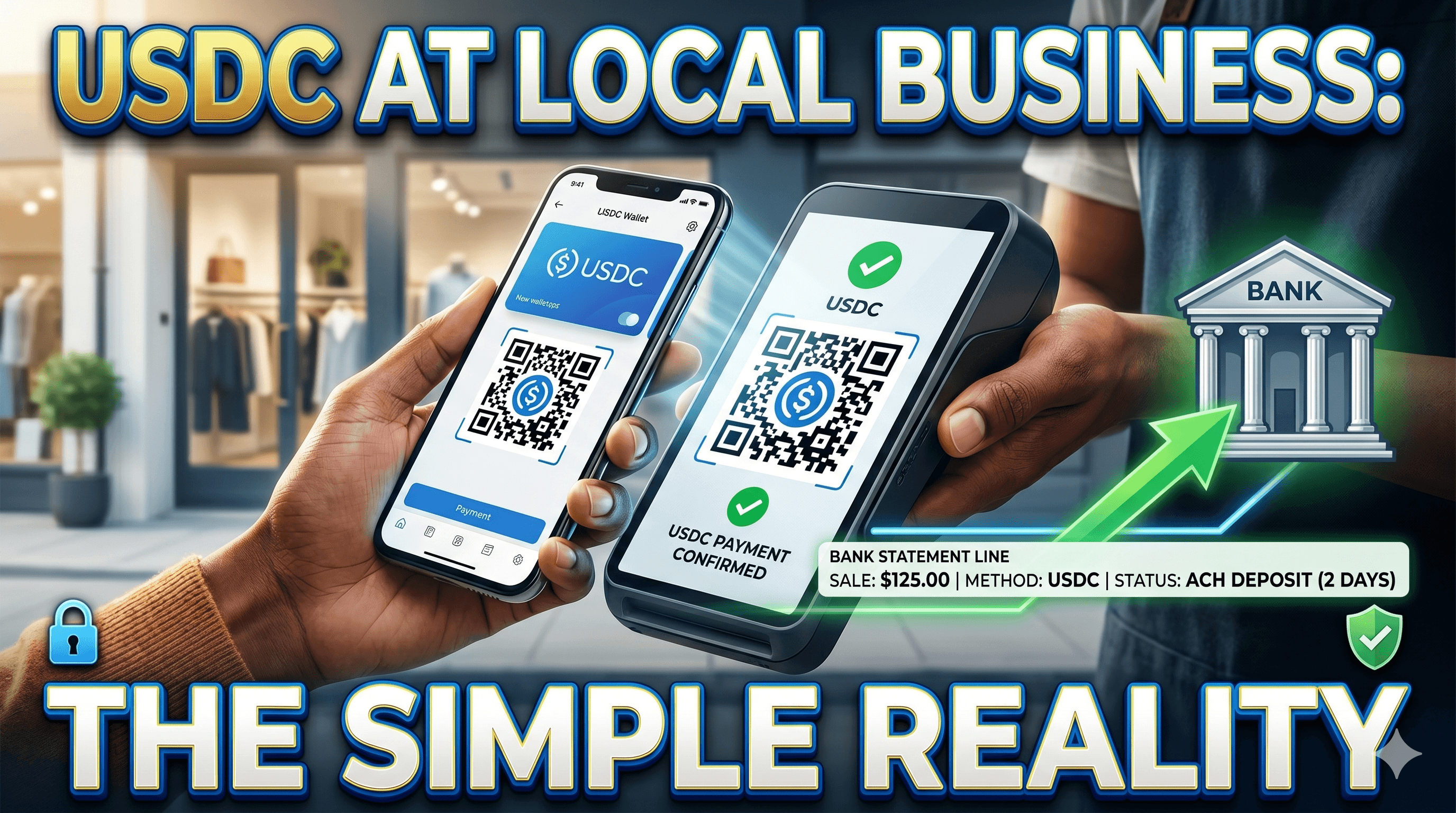
You place payment devices at local businesses. Those businesses' customers pay with crypto. The processor converts it to dollars instantly. The merchant gets paid in dollars. You earn a percentage of every transaction processed, for as long as that merchant stays open and accepting payments.
No coins. No price charts. No volatility. No employees. No inventory. No overnight calls about broken equipment.
A 40-year-old business model, applied to the payment technology that 70 million Americans already own — before the window closes.
If she wants to see the full mechanics before she makes up her mind, point her to the overview at Dividend Shift. Not a pitch. Not a sales call. Just the model, the numbers, and how the placement process actually works.
She's going to have questions. That's the right response. A spouse who asks hard questions is a business partner worth having.
Gedam Tekle is a former U.S. Marine and Oakland Police Sergeant who left law enforcement to build crypto payment infrastructure businesses. He has personally exited two eight-figure companies and helped over 4,000 entrepreneurs build residual income. He is the founder of Dividend Shift.