
Published on:
Crypto Payment Terminals vs. Vending Machines — Which Boring Business Is Better in 2026?
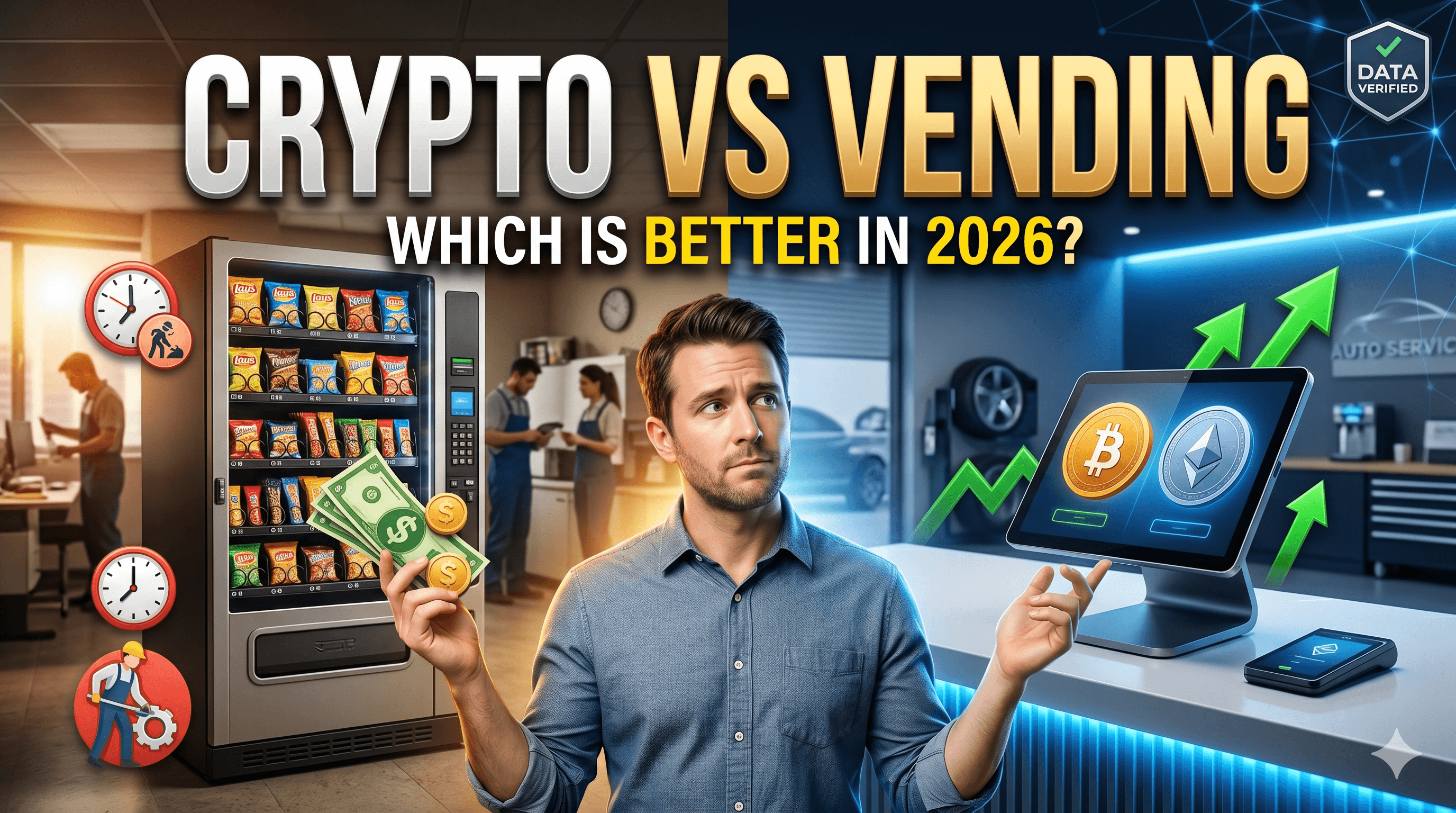
Quick Answer: Both are legitimate boring businesses. But they are not equal. A vending machine nets $40–$120/month per machine after product costs, restocking labor, and location commissions — and requires a physical visit to every machine 1–4 times per month. A crypto payment terminal generates an estimated $200–$1,000/month per location in residual income with no restocking, no cash handling, and no driving routes. The structural difference isn't income — it's what the business looks like at 20 locations.
The people who research vending machines are the same people who research crypto payment terminals.
They're not looking for a shortcut. They want something real — a business that runs without them, pays them monthly, and doesn't require a boss. Both models attract the same buyer. The question is which one delivers on that promise at scale.
Here's the honest comparison.
How Does a Vending Machine Business Actually Make Money?
The math is simple. A machine gets placed at a location — an office building, gym, school, apartment complex. It sells snacks, drinks, or specialty items. The operator pockets the difference between wholesale cost and the machine's retail price.
A can of soda costs roughly $0.35 wholesale. The machine sells it for $1.75. That's $1.40 gross margin per unit. Multiply by daily unit volume, subtract costs, and that's the income.
In practice, the numbers work out like this: a single well-placed machine grosses $300–$600/month. After product restocking costs — which consume 30%–50% of gross revenue — and location commissions to the building or business where the machine sits (another 10%–25% of gross), a small operator nets $40–$120/month per machine. Established operators with optimized routes and better wholesale pricing can reach $200–$400 net per machine, but that takes time and volume.
The U.S. vending industry generated $7.7 billion in revenue in 2025. The business is real. The income is real.
But here's what comes after the YouTube videos: the work.
Every machine has to be restocked. Every 1–4 weeks, the operator drives to the location, pulls expired or low-stock product, reloads it, collects cash or checks card reader data, and notes what's selling. At 10 machines, that's a recurring schedule. At 30, it's a route.
If a machine jams, someone goes to fix it. If a location closes, the machine has to move. If the location owner decides they want a different vendor, that placement is gone and the acquisition process starts over.
The income is real. The passive nature of it is partial, at best.
How Does a Crypto Payment Terminal Business Actually Make Money?
A crypto payment terminal is a point-of-sale device placed at a local brick-and-mortar business. Customers pay with Bitcoin, Ethereum, USDC, or other supported crypto. The merchant receives dollars automatically — no crypto exposure, no volatility risk on their end.
The operator who placed the terminal earns a residual percentage of every transaction processed. Typically 0.5%–1% of transaction value, flowing from the processor's fee split on every transaction, every month, for as long as that merchant keeps processing.
That income isn't tied to how many units sell on a Tuesday. It's tied to the merchant's total crypto transaction volume. An auto shop doing $40,000/month in crypto transactions generates $200–$400/month for the operator. A dental office at $30,000/month generates $150–$300/month.
No product. No restocking. No driving. No cash to collect.
The residual deposits automatically from the processor. The operator doesn't invoice the merchant or pick up a check. The income is triggered by transaction volume that happens whether or not the operator shows up.
That distinction — discrete income per product sale versus continuous residual income from transaction volume — is the structural difference between the two models.
The Side-by-Side Comparison
Vending Machine | Crypto Payment Terminal | |
|---|---|---|
Startup cost per unit | $1,500–$10,000 | $200–$1,500 |
Monthly income per unit (net) | $40–$400 | $200–$1,000 |
Cash handling required | Yes — every restocking visit | No |
Physical labor per unit/month | 1–4 restocking visits | None after placement |
Driving routes required | Yes — every machine, every cycle | No |
Equipment maintenance | Yes — jams, repairs, calibration | Minimal |
Location commission to owner | 10%–25% of gross | None |
Income type | Discrete per-sale | Continuous residual |
Market growth trend | Flat to 1.2% annually (IBISWorld) | 125%+ year-over-year stablecoin retail growth |
Scalability ceiling | Physical — limited by time and routes | No physical constraint |
Which Business Has Lower Startup Costs?
On a per-unit basis, crypto terminals are cheaper to enter. A vending machine runs $1,500–$10,000 depending on type and features. A crypto terminal runs $200–$1,500 in equipment.
The more meaningful cost comparison is what's required to generate income worth building around.
To net $2,000/month from vending machines at $150/month average per machine, an operator needs roughly 14 machines. At $3,000 average cost per machine, that's $42,000 in equipment before the business reaches $2,000/month.
To net $2,000/month from crypto terminals at $300/month average per location, an operator needs roughly 7 placements. At $1,000 average equipment cost per terminal, that's $7,000 in equipment — plus the business entry investment — to reach the same threshold.
The vending model requires more capital deployed in physical assets to reach the same income level. And that capital stays locked in machines sitting in locations the operator doesn't control.
Which Business Requires Less Weekly Time Once Running?
This is where the comparison gets decisive.
Vending machines are not passive once they're running. They require a physical presence at every location on a recurring cycle. At 10 machines with a weekly restocking schedule, that's 10 physical visits per week. That's a part-time job. At 30 machines, it's a full route — which is why most successful vending operators eventually hire a driver.
Hiring a driver is fine. But the moment there's payroll, the passive income business becomes a small business with employees, scheduling, and operational management.
Crypto payment terminals require 1–3 hours per week to manage a portfolio of active locations. That time covers checking transaction reports, responding to merchant questions, and occasional visits to maintain the relationship. It does not involve driving routes, handling cash, or managing product inventory.
Beacon Payments — one of the established merchant services networks — describes their most tenured agents this way: some haven't placed a new account in five years and still earn consistent monthly residuals from their existing portfolio.
That's what the endpoint of the passive income model actually looks like.
Which Business Is Positioned Better for the Next 5 Years?
Vending machine revenue in the U.S. has grown at roughly flat to 1.2% annually. The market is mature. Locations are competitive. And the consumer trend — away from cash, away from physical-only retail interactions, toward mobile payments and on-demand delivery — is not a tailwind for a machine that takes physical coins and bills and dispenses a bag of chips.
The vending operators doing well right now are the ones who locked in good locations years ago. New entrants are competing for what's left.
Stablecoin retail transaction volume grew 125%+ year-over-year from 2024 to 2025. There are 70 million crypto owners in the U.S. and fewer than 2,300 businesses accepting crypto at the local level — roughly 30,000 crypto holders for every accepting business. That gap between consumer demand and merchant infrastructure is the market opportunity.
PayPal launched crypto payments for U.S. merchants in July 2025. Square launched Bitcoin processing in November 2025. Stripe partnered with Crypto.com in January 2026. These companies are validating the category and moving toward it — which means independent operators who build local merchant relationships now are doing so before the institutional players close the gap.
Vending machines are not a bad business. They're a mature business with a flat trajectory.
Crypto payment terminals are an early-stage infrastructure business with a documented growth curve and a limited window before the category gets crowded.
Those are not equivalent positions.
What the Comparison Comes Down To
The person who researches both businesses is asking the same underlying question: what does this look like when I have 25 units?
For vending, the answer is a driving route, a restocking schedule, a parts supplier relationship, and probably a part-time employee to cover the route during busy weeks. That's a real business — but not the one most people who researched it were hoping to build.
For crypto payment terminals, the answer is a dashboard, a portfolio of merchant relationships, and a residual payment that lands monthly without requiring a physical presence.
Both models generate real income. One of them compounds without adding labor. In 2026, with the regulatory framework in place and merchant demand documented, that distinction matters more than it ever has.
The Dividend Shift Team supports partners building residual income through crypto payment terminal placement. Dividend Shift was founded by Gedam Tekle, a former U.S. Marine and Oakland Police Sergeant who has personally exited two eight-figure companies and helped over 4,000 entrepreneurs build infrastructure-based businesses.