Published on:
How to Get Your First Crypto Payment Terminal Placed (The Merchant Conversation That Works)
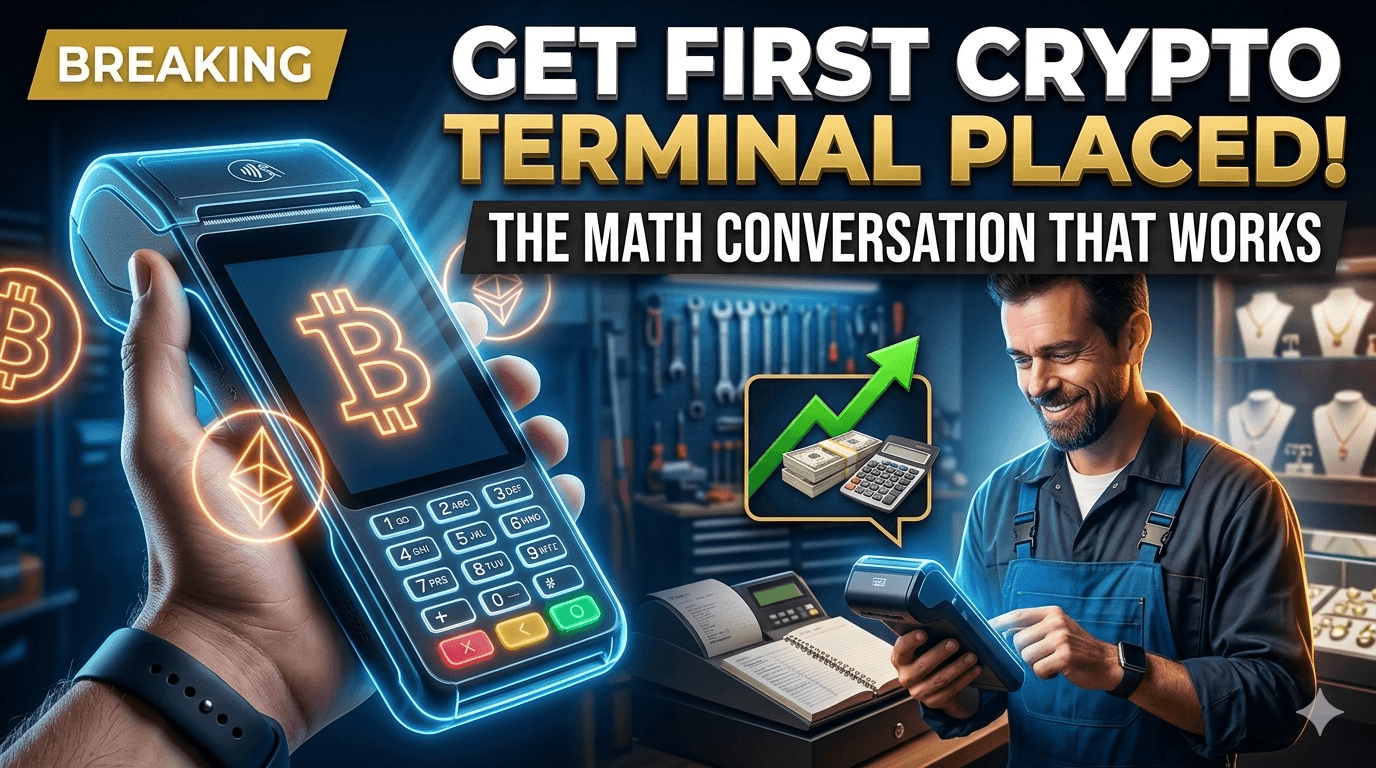
Quick Answer: The merchant conversation is not a crypto pitch — it's a math conversation. Lead with what the merchant loses every month to card processing fees and chargebacks, not with what you earn. On a $1,000 transaction, a standard card processor takes $29–$35. A crypto terminal takes $5–$10. That gap is the conversation opener, and 88% of merchants are already getting asked by their customers to accept crypto. You're not introducing a concept. You're handing them a solution to a problem they already know they have.
Here's what I tell every new partner who asks me about the merchant conversation.
Stop thinking about it as a sales call.
A sales call is when you walk into a room, explain a product, overcome objections, and try to close someone on something they didn't know they needed. That's a hard room. Most people aren't built for it, and even the ones who are find it exhausting.
What you're actually doing is a math conversation. You're walking into a business and asking the owner one question: how much are you paying your card processor every month? Then you show them a better number. If the number makes sense — and it almost always does — the conversation closes itself.
I've done this. I've watched partners do it hundreds of times. The mechanics are simpler than most people expect. Here's exactly how it works.
What Is the First Thing to Say When You Walk Into a Merchant?
Not "have you heard of crypto payments?" Not "I have a business opportunity for you." Both of those sentences start the wrong conversation.
The first thing to say is about their processing fees.
Every owner-operated business paying a card processor knows exactly how painful that line item is. The National Retail Federation has called card processing fees the highest operating cost for most merchants after labor. Standard Stripe and Square published rates run 2.9% plus $0.30 per transaction. Premium rewards cards — the ones customers love because they get airline miles — push that to 4.5%–6% of the transaction value. That's not a rounding error. On a $1,000 repair job, the merchant is handing $29–$60 to the processor before a single dollar hits their pocket.
Start there.
"Hey, quick question — what are you paying your card processor right now per transaction?"
Most owners know. They feel it. And when they tell you the number, you follow with the comparison.
"What if you could offer your customers an option that costs you 0.5%–1% instead of 2.9%? You keep the difference. The customer pays the same."
On that same $1,000 transaction: $29–$35 with a card processor, $5–$10 with a crypto terminal. The merchant pockets the difference as recovered margin.
That's the opening. Everything after it is just answering questions.
What Objections Will You Hear — And How Do You Answer Them?
Four objections come up in almost every conversation. Here's what they sound like and how to respond without sounding like a salesperson.
"My customers don't use crypto."
This is the most common objection, and it's the easiest to disprove with data. The NCA/PayPal January 2026 survey of 619 payment decision-makers found 88% of merchants already receive customer inquiries about paying with crypto. 69% say those requests arrive at least monthly.
Turn the question back on them: "Have you ever had a customer ask if you take crypto?" Almost every owner has. When they say yes — and they will — the objection dissolves. You're not introducing something unknown to their customer base. Their customer base is already asking for it.
"I don't want to deal with the volatility."
This one signals a misunderstanding about how the terminal actually works, and it's worth taking 60 seconds to explain clearly.
The merchant never holds crypto. Ever. The customer pays in Bitcoin, Ethereum, or USDC. The exchange rate is locked at the moment of the transaction. The processor converts it to dollars immediately. The merchant receives USD in their bank account in 1–2 business days. The experience is identical to processing any other digital payment. There is no volatility exposure. The price of Bitcoin on Monday morning has zero effect on what the merchant received on Saturday.
Steak 'n Shake's COO reported 50% savings in processing fees after adopting Bitcoin payments. They weren't running a crypto treasury. They were running a business that offered customers another way to pay and kept more of every transaction. That's all this is.
"What about chargebacks? Can customers reverse the payment?"
No. This is the part of the conversation where most merchants lean forward.
Card chargebacks cost U.S. merchants $117.47 billion in 2023. For every dollar lost to fraud, the true cost — dispute fees, labor, lost merchandise — is $4.61. Merchants win only 8%–18% of the disputes they contest. Friendly fraud, where a customer disputes a legitimate charge they know they made, accounts for up to 80% of chargeback losses.
Crypto transactions are irreversible by design. Once confirmed on the blockchain, no bank, card network, or third party can reverse the payment. The merchant can choose to issue a refund — but the customer cannot initiate a dispute that takes the money back without the merchant's involvement. That's not a feature of the payment processor. It's how the underlying technology works.
For an auto shop owner who lost $3,000 last year fighting disputed repair invoices, this stops the conversation cold. In a good way.
"Is this legal? Do I need to do anything special?"
Short answer: yes, it's legal, and the compliance burden lives at the processor level — not at the merchant's level.
The merchant doesn't register with anyone. They don't file anything. They add a payment option the same way they'd add Apple Pay. The processor — which holds the required federal registrations and state money transmitter licenses — handles all of it on the back end.
The GENIUS Act, signed July 18, 2025, established the first comprehensive federal framework for digital payment stablecoins. The vote was 68–30 in the Senate and 308–122 in the House. The regulatory uncertainty that existed before 2025 is substantially resolved. The OCC has granted federal banking charters to Circle, BitGo, Paxos, Fidelity Digital Assets, and Ripple. This is not a fringe operation.
What Happens After the Merchant Says Yes?
The placement process is more straightforward than most people expect.
The merchant signs a simple agreement with the processor. A device ships directly to their location — or you bring it. Setup takes roughly 30–60 minutes: the device connects to their existing internet, the payment screen is configured, and staff gets a 10-minute walkthrough on how to process a transaction.
ForumPay documents a 99.99% transaction approval rate across its merchant network. The technology is not experimental. It processes cleanly.
The merchant doesn't need to promote it aggressively at launch. Some operators put a small sign at the register — "We accept crypto." That's enough to activate the customers who were already looking for it. The NCA/PayPal data shows 88% of merchants were already getting asked. The sign answers the question before it's asked.
Your job after placement is minimal. The residuals flow automatically from the transaction volume. You're not checking in daily. You're not managing the technology. You might stop by quarterly to make sure everything's running, answer any questions the owner has, and check if they want any additional marketing materials.
That's the ongoing relationship. One visit per quarter, per location.
How Long Does It Take to Get a Terminal Active After Placement?
From initial conversation to live terminal: roughly 1–3 weeks for a motivated merchant.
The timeline breaks down like this: the first conversation takes 20–30 minutes if you've done your pre-call research and walked in knowing their transaction volume category. Agreement signing is typically the same day or within a week. Device setup and activation takes less than a day once equipment arrives. First transaction happens whenever the first customer opts to pay with crypto.
Some merchants move in 48 hours. Others take 2–3 weeks to loop in their office manager or check in with their accountant. The categories that move fastest — owner-operated auto shops, independent jewelry stores, tech retail — have the decision-maker behind the counter when you walk in.
The categories that move slower — dental practices, professional service firms with multiple stakeholders — take 2–4 weeks. Not because they're harder to convince, but because more people have to sign off.
Plan your pipeline accordingly. Talk to 10 merchants in week one. Expect 2–3 to close quickly, 3–4 to follow within the month, and a few to go quiet. That's a normal conversion pattern for any B2B placement business.
What Does the Ongoing Merchant Relationship Actually Look Like?
Lighter than most people expect.
The merchant runs their business. The terminal processes transactions. You receive a residual deposit every month from the processor. The volume reports are automatic. The deposits are automatic. There's no invoice to send, no follow-up required to trigger payment.
Your ongoing obligation is relationship maintenance — which in this context means being the person the merchant can call if they have a question, making sure the device is functioning, and occasionally checking whether they want to add a second terminal at a second location.
That last point matters. The operators who scale fastest don't just add new merchants. They go deep with the merchants they already have. A busy auto shop might want a second terminal in the waiting area. A dental practice with two locations might expand after seeing the volume from the first.
Your existing merchant relationships are your warmest expansion opportunities. Treat them like it.